
The following additional facts are known regarding the number of stars received by the bloggers from the surfers.
1. The numbers of stars received by the bloggers from the surfers were all multiples of 5 (including 0).
2. The total numbers of stars received by the bloggers were the same.
3. Each blogger received a different number of stars from M.
4. Two surfers gave all their stars to a single blogger.
5. D received more stars than C from Y.
What was the total number of stars received by D?
Solution :
The correct answer is 45.
Step-by-step Explanation:
1. Analysis of the Graph and Surfer Data:
From the provided image, we can identify the following facts:
• There are six web surfers: M, N, O, P, X, and Y.
• There are four bloggers: A, B, C, and D.
• Each web surfer has a total of 30 stars to distribute among the four bloggers.
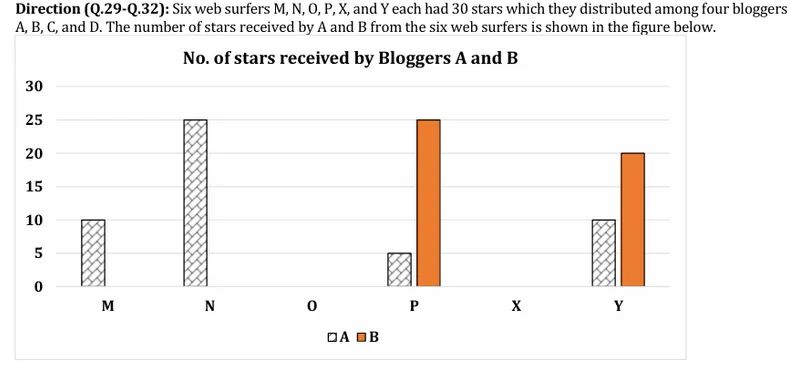
From the bar chart titled "No. of stars received by Bloggers A and B", we can observe the stars received by A and B from each surfer:
• Surfer M: 10 stars to A, 0 stars to B
• Surfer N: 25 stars to A, 0 stars to B
• Surfer O: 0 stars to A, 0 stars to B
• Surfer P: 5 stars to A, 25 stars to B
• Surfer X: 0 stars to A, 0 stars to B
• Surfer Y: 10 stars to A, 20 stars to B
2. Calculation of Total Stars:
Since each of the 6 surfers has 30 stars, the total number of stars distributed by all surfers to all bloggers is:
3. Distribution of Stars to Each Blogger:
According to Fact 2: "The total numbers of stars received by the bloggers were the same."
Since there are 4 bloggers (A, B, C, and D) and the total number of stars is 180, the number of stars received by each blogger must be equal.
Let be the total number of stars received by each blogger.
Therefore, each blogger, including blogger D, received a total of 45 stars.
Completely free for students. Educators & coaching institutes get 2 months free Pro trial to create tests.
Access unlimited practice questions, detailed step-by-step solutions, and exam study materials — completely free for students.
Create and conduct professional online assessments with AI question generation, tab proctoring, and comprehensive batch management.

Practice the complete CLAT 2015 UG Question Paper to improve your preparation for the Common Law Admission Test. This previous year paper covers the key sections of CLAT UG, including English, General Knowledge & Current Affairs, Elementary Mathematics, Legal Aptitude, and Logical Reasoning. Solve CLAT 2015 UG questions to understand the previous year exam pattern, practice important concepts, improve accuracy and speed, and prepare effectively for law entrance examinations.

Prepare for CLAT 2019 UG with the complete question paper and solutions. This paper covers all major sections of the Common Law Admission Test (CLAT) Undergraduate exam, including English Language, Current Affairs & General Knowledge, Legal Reasoning, Logical Reasoning, and Quantitative Techniques.Use the CLAT 2019 UG question paper to practice exam-level questions, understand the question pattern, improve time management, and strengthen your preparation for law entrance examinations.
Copyright © 2026 Combe Labs Private Limited. All Rights Reserved.


