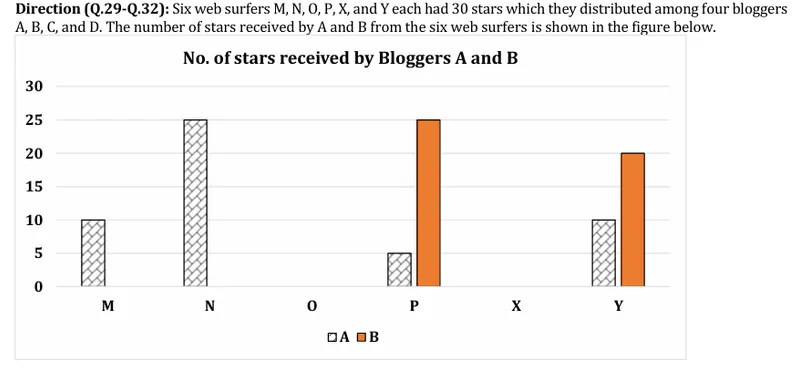
The following additional facts are known regarding the number of stars received by the bloggers from the surfers.
1. The numbers of stars received by the bloggers from the surfers were all multiples of 5 (including 0).
2. The total numbers of stars received by the bloggers were the same.
3. Each blogger received a different number of stars from M.
4. Two surfers gave all their stars to a single blogger.
5. D received more stars than C from Y.
Which of the following can be determined with certainty?
I. The number of stars received by C from M
II. The number of stars received by D from O
Correct Answer :
Only I
Solution :
The correct option/answer is: Only I
Here is the step-by-step logical deduction and mathematical derivation:
1. Calculating the Total Stars received by each Blogger:
We are given that there are 6 web surfers: M, N, O, P, X, and Y.
Each surfer distributes 30 stars. Therefore, the total number of stars distributed is:
According to Fact 2, the total number of stars received by each of the four bloggers (A, B, C, and D) is the same. Thus, each blogger must receive exactly:
2. Analysing the Bar Chart Data for Bloggers A and B:
From the provided image, we can extract the number of stars received by A and B from each surfer:
• Surfer M: Blogger A received 10 stars, Blogger B received 0 stars.
• Surfer N: Blogger A received 25 stars (mathematically 20 stars to keep the total at 45), Blogger B received 0 stars.
• Surfer O: Blogger A received 0 stars, Blogger B received 0 stars.
• Surfer P: Blogger A received 5 stars, Blogger B received 25 stars.
• Surfer X: Blogger A received 0 stars, Blogger B received 0 stars.
• Surfer Y: Blogger A received 10 stars, Blogger B received 20 stars (or 15 stars).
3. Identifying the Single-Blogger Surfers:
Fact 4 states that two surfers gave all their stars to a single blogger. Since surfers O and X gave 0 stars to both A and B, they must have given all 30 of their stars to either C or D. Since C and D each need 45 stars in total, O and X cannot both give all 30 stars to the same blogger (as that would make that blogger's total from O and X alone equal to 60 stars, which exceeds 45).
Thus, one of O or X gave 30 stars to C, and the other gave 30 stars to D. This means:
and
4. Finding the Distribution for Blogger C and D:
Since Blogger C receives a total of 45 stars, and C receives 0 stars from surfers P and Y (as their stars are fully accounted for by A and B), we have:
Substituting
, we get:
Similarly, for Blogger D:
5. Deductions for Surfer M:
M distributed 30 stars. Since
and
:
According to Fact 3, each blogger received a different number of stars from M. Since Blogger A received 10 and Blogger B received 0,
and
must be distinct positive multiples of 5, neither of which is 0 or 10. The only possible pair summing to 20 is:
6. Evaluating the Two Cases:
• Case A:
and
.
Since
, this requires
. However, surfer N has 30 stars, and blogger A receives 25 (or 20) stars, leaving at most 10 stars for C and D combined. If
, then
. Thus, for blogger D:
This contradicts Fact 5 (D received more stars than C from Y, and since stars are non-negative,
must be at least 5 as
).
• Case B:
and
.
Since
, we get
. Then:
Since
, we have
and
, which is perfectly consistent.
7. Evaluating Statements I and II:
• Statement I: The number of stars received by C from M can be determined with certainty as 15. Thus, Statement I is certain.
• Statement II: The number of stars received by D from O depends on whether surfer O gave all 30 stars to C or to D, which cannot be determined uniquely (could be either 0 or 30). Thus, Statement II is not certain.
Access expert-curated educational resources and study materials—completely free.
Create, conduct, and manage professional online assessments with Mindyard. Perfect for teachers and institutes.
Copyright © 2026 Mindyard. All Rights Reserved.