The following are the items appearing in Equities and Liabilities side of Balance Sheet
(A) Deferred tax Assets (Net)
(B) Reserve and Surplus
(C) Deferred tax Liabilities (Net)
(D) Long term borrowings
(E) Long term loans and Advances
Choose the correct answer from the options given below:
Solution :
The correct answer is (B), (C) and (D) only.
To understand why this is the correct choice, let us analyze the nature of each item listed in the question and determine whether it appears on the Equities and Liabilities side or the Assets side of a standard Balance Sheet (in accordance with Schedule III of the Companies Act, 2013):
(A) Deferred tax Assets (Net): This represents the tax that a company has overpaid or paid in advance, which will be adjusted against future tax liabilities. Because it represents a future economic benefit, it is classified as a non-current asset and appears on the Assets side of the Balance Sheet. Therefore, it is excluded.
(B) Reserve and Surplus: This represents the accumulated profits and retained earnings of the company after paying dividends and other appropriations. It belongs to the shareholders and is classified under "Shareholders' Funds" on the Equities and Liabilities side of the Balance Sheet. Therefore, it is included.
(C) Deferred tax Liabilities (Net): This arises when taxable income is less than accounting income due to temporary timing differences, resulting in tax that will be payable in future periods. It is classified under "Non-Current Liabilities" on the Equities and Liabilities side of the Balance Sheet. Therefore, it is included.
(D) Long term borrowings: These are financial obligations or debts of the company that are due for repayment after a period of twelve months or operating cycle (such as debentures, bonds, or long-term bank loans). They are classified under "Non-Current Liabilities" on the Equities and Liabilities side of the Balance Sheet. Therefore, it is included.
(E) Long term loans and Advances: These represent loans and advances given by the company to other entities that are expected to be recovered or adjusted after twelve months. Since this is money owed to the company, it represents an asset and is classified under "Non-Current Assets" on the Assets side of the Balance Sheet. Therefore, it is excluded.
Comparing our findings, only items (B), (C), and (D) belong to the Equities and Liabilities side, making (B), (C) and (D) only the correct answer.
Completely free for students. Educators & coaching institutes get 2 months free Pro trial to create tests.
Access unlimited practice questions, detailed step-by-step solutions, and exam study materials — completely free for students.
Create and conduct professional online assessments with AI question generation, tab proctoring, and comprehensive batch management.
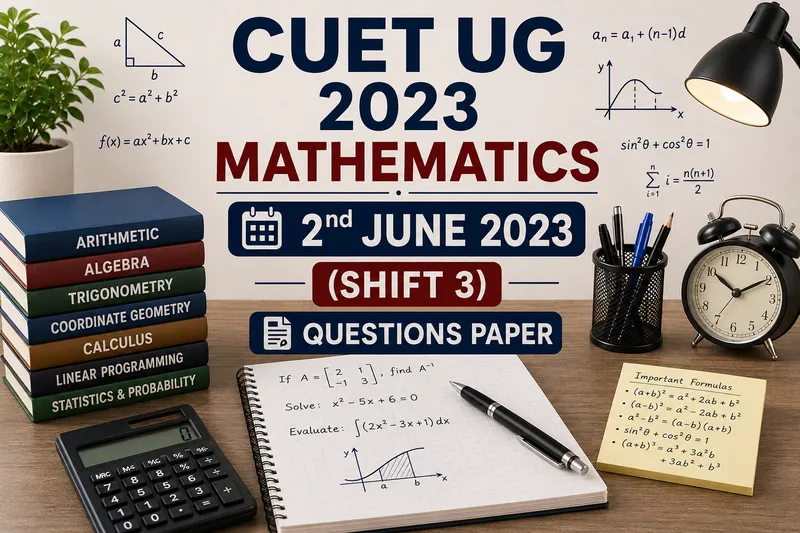
A comprehensive CUET UG Mathematics Question Paper with Solutions – 2 June 2023 (Shift 3) designed to help students practice and understand the actual CUET exam pattern. This paper covers important topics from Algebra, Calculus, Coordinate Geometry, Probability, Statistics, Matrices, Determinants, and Vectors, featuring a balanced mix of conceptual, numerical, and application-based questions. Detailed solutions are provided to strengthen problem-solving skills, improve conceptual clarity, and enhance calculation accuracy. Based on the CUET syllabus and previous year exam trends, this paper is ideal for practice, revision, self-assessment, time management, previous year analysis, and final preparation for upcoming CUET UG Mathematics examinations.
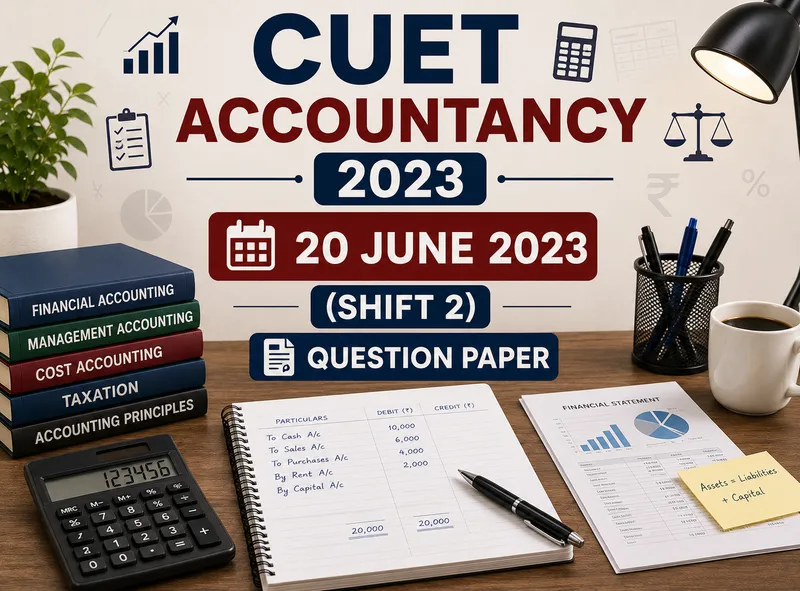
A comprehensive CUET Accountancy Question Paper – 20 June 2023 (Shift 2) designed to help students practice and analyze previous year exam patterns for effective CUET preparation. This paper covers important topics including Accounting for Partnership Firms, Company Accounts, Financial Statements Analysis, Cash Flow Statements, Accounting Ratios, and Fundamental Accounting Principles. It features a balanced mix of conceptual, numerical, and application-based questions to strengthen accounting concepts, improve calculation accuracy, and enhance problem-solving skills. Based on the CUET exam structure and syllabus, this paper is ideal for practice, revision, self-assessment, time management, previous year analysis, and final preparation for upcoming CUET Accountancy examinations.
Copyright © 2026 Combe Labs Private Limited. All Rights Reserved.