
The following charts depict details of research papers written by four authors, Arman, Brajen, Chintan, and Devon.
The papers were of four types, single-author, two-author, three-author, and four-author, that is, written by one, two, three, or all four of these authors, respectively. No other authors were involved in writing these papers.
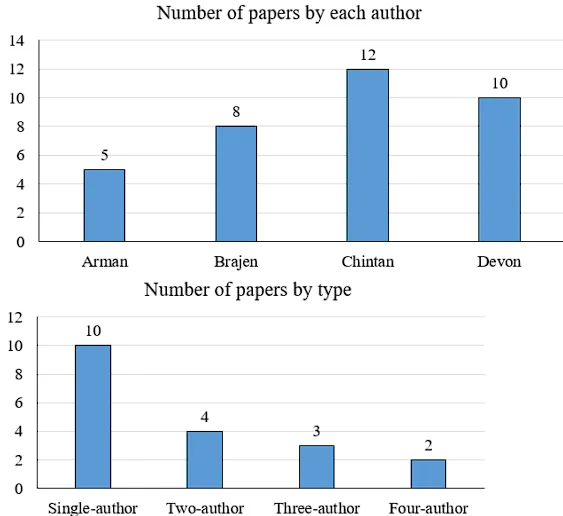
The following additional facts are known.
1. Each of the authors wrote at least one of each of the four types of papers.
2. The four authors wrote different numbers of single-author papers.
3. Both Chintan and Devon wrote more three-author papers than Brajen.
4. The number of single-author and two-author papers written by Brajen were the same.
What was the total number of two-author and three-author papers written by Brajen?
Solution :
The correct answer is 4.
Based on the provided charts in the image, we can extract two vital sets of data to begin our deduction. The first chart (a bar chart) shows the total number of papers written by each author: Arman (12), Brajen (8), Chintan (14), and Devon (11). The second chart (a pie chart) shows the overall distribution of the types of research papers published: 10 single-author, 11 two-author, 3 three-author, and 1 four-author papers.
We need to determine the total number of two-author and three-author papers written by Brajen. Let us define the variables for Brajen's paper counts as B1 for single-author papers, B2 for two-author papers, B3 for three-author papers, and B4 for four-author papers.
According to the image data, there is exactly 1 four-author paper in total. Since a four-author paper must involve all four authors working together, Brajen must have co-authored exactly 1 four-author paper. Therefore:
The first chart shows that Brajen wrote a total of 8 papers. We can write this as an equation summing all his paper types:
Substituting the known value of his four-author papers into this equation yields:
Next, we use the additional facts provided in the problem description. Fact 4 states that the number of single-author and two-author papers written by Brajen were the same. This establishes that:
Substituting B2 for B1 into our previous equation gives us a simplified equation purely in terms of two-author and three-author papers:
Fact 1 establishes that each author wrote at least one of each type of paper. Consequently, both B2 and B3 must be positive integers strictly greater than zero.
Now, we can test the possible positive integer pairs that satisfy our equation. Let us evaluate them case by case:
Case 1: If B2 = 1, then B3 = 5.
This implies Brajen wrote 5 three-author papers. However, the pie chart from the image clearly shows there are only 3 three-author papers in total. An author cannot write more papers of a given type than exist in total, so this case is logically impossible.
Case 2: If B2 = 2, then B3 = 3.
This implies Brajen wrote 3 three-author papers. Let us check Fact 3, which states that both Chintan and Devon wrote more three-author papers than Brajen. If Brajen wrote 3, then Chintan and Devon would each need to write at least 4. As established by the chart, there are only 3 three-author papers in total, making it impossible for anyone to write 4. Thus, this case is also logically invalid.
Case 3: If B2 = 3, then B3 = 1.
This leaves 1 three-author paper for Brajen. Fact 3 requires Chintan and Devon to write more three-author papers than Brajen, meaning they must write at least 2. Because there are exactly 3 three-author papers in total, Chintan and Devon can easily co-author 2 or 3 of them, perfectly satisfying all constraints without exceeding the total limit. This case is completely valid.
Having deduced the exact distribution of Brajen's papers through elimination, we find that he wrote exactly 3 two-author papers and 1 three-author paper. The final step is to find the combined total of these two specific types:
This mathematical derivation conclusively demonstrates that the total number of two-author and three-author papers written by Brajen is 4.
Completely free for students. Educators & coaching institutes get 2 months free Pro trial to create tests.
Access unlimited practice questions, detailed step-by-step solutions, and exam study materials — completely free for students.
Create and conduct professional online assessments with AI question generation, tab proctoring, and comprehensive batch management.

Practice the complete CLAT 2015 UG Question Paper to improve your preparation for the Common Law Admission Test. This previous year paper covers the key sections of CLAT UG, including English, General Knowledge & Current Affairs, Elementary Mathematics, Legal Aptitude, and Logical Reasoning. Solve CLAT 2015 UG questions to understand the previous year exam pattern, practice important concepts, improve accuracy and speed, and prepare effectively for law entrance examinations.

Prepare for CLAT 2019 UG with the complete question paper and solutions. This paper covers all major sections of the Common Law Admission Test (CLAT) Undergraduate exam, including English Language, Current Affairs & General Knowledge, Legal Reasoning, Logical Reasoning, and Quantitative Techniques.Use the CLAT 2019 UG question paper to practice exam-level questions, understand the question pattern, improve time management, and strengthen your preparation for law entrance examinations.
Copyright © 2026 Combe Labs Private Limited. All Rights Reserved.


