
The following charts depict details of research papers written by four authors, Arman, Brajen, Chintan, and Devon.
The papers were of four types, single-author, two-author, three-author, and four-author, that is, written by one, two, three, or all four of these authors, respectively. No other authors were involved in writing these papers.
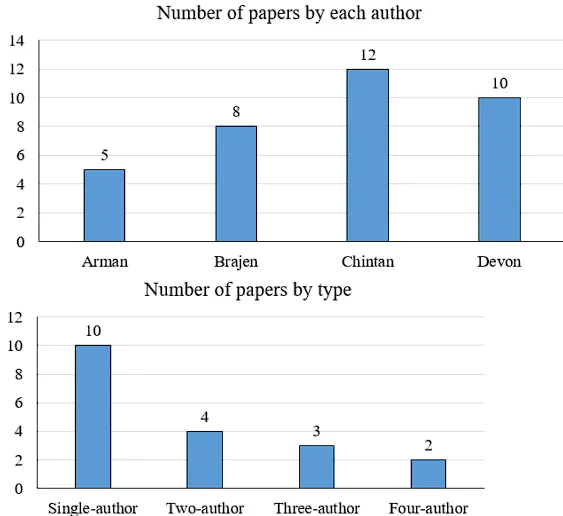
The following additional facts are known.
1. Each of the authors wrote at least one of each of the four types of papers.
2. The four authors wrote different numbers of single-author papers.
3. Both Chintan and Devon wrote more three-author papers than Brajen.
4. The number of single-author and two-author papers written by Brajen were the same.
If Devon wrote more than one two-author papers, then how many two-author papers did Chintan write?
Correct Answer :
Solution :
Based on the provided charts in the image, we can extract the following values:
Number of papers by each author:
• Arman: 5 papers
• Brajen: 8 papers
• Chintan: 12 papers
• Devon: 10 papers
Number of papers by type:
• Single-author papers (written by 1 author): 10 papers
• Two-author papers (written by 2 authors): 4 papers
• Three-author papers (written by 3 authors): 3 papers
• Four-author papers (written by 4 authors): 2 papers
Let the number of papers of type i (where i is 1, 2, 3, or 4) written by Arman, Brajen, Chintan, and Devon be represented by , , , and respectively.
Since there are exactly 2 four-author papers and no other authors are involved, all four authors must have worked on them together. Thus:
According to Fact 1, each author wrote at least one paper of each of the four types. Therefore, for all i in {1, 2, 3, 4}:
Now, we look at the total papers written by Arman:
Substituting
:
Since each must be at least 1, we must have:
,
, and
.
According to Fact 2, the four authors wrote different numbers of single-author papers. Thus,
,
,
, and
are distinct positive integers.
Since the total number of single-author papers is 10, we have:
Knowing
, the remaining numbers must be distinct positive integers greater than 1. The only possible set of four distinct positive integers that sums to 10 is {1, 2, 3, 4}. Therefore:
Let us examine the total papers written by Brajen:
Substituting
:
According to Fact 4, the number of single-author and two-author papers written by Brajen are the same, which means:
Substituting this in the equation:
Since
must be in {2, 3, 4} (as
) and
, the only possible solution is:
(which gives
).
Therefore, we have:
,
, and
.
Now, consider the total number of three-author papers. Since each of the 3 three-author papers is co-authored by exactly 3 authors, the sum of three-author papers across all authors must be:
Substituting
and
:
According to Fact 3, both Chintan and Devon wrote more three-author papers than Brajen:
and
Given that
, and both must be integers strictly greater than 2, the only possible values are:
and
.
Since
, and
, we have:
Let us write the equations for Devon's papers:
Substituting
and
:
Now we analyze the condition given in the question: "Devon wrote more than one two-author papers," which means:
Since
must be either 3 or 4:
• If
, then
(which violates the condition
).
• If
, then
(which satisfies
).
Therefore, we must have:
and
.
Since
and
, it follows that:
.
Now we determine the number of two-author papers written by Chintan. For Chintan:
Substituting
,
, and
:
Thus, the number of two-author papers written by Chintan is 3.
The correct answer is 3.
Access expert-curated educational resources and study materials—completely free.
Create, conduct, and manage professional online assessments with Mindyard. Perfect for teachers and institutes.
Copyright © 2026 Mindyard. All Rights Reserved.




