
The following charts depict details of research papers written by four authors, Arman, Brajen, Chintan, and Devon.
The papers were of four types, single-author, two-author, three-author, and four-author, that is, written by one, two, three, or all four of these authors, respectively. No other authors were involved in writing these papers.
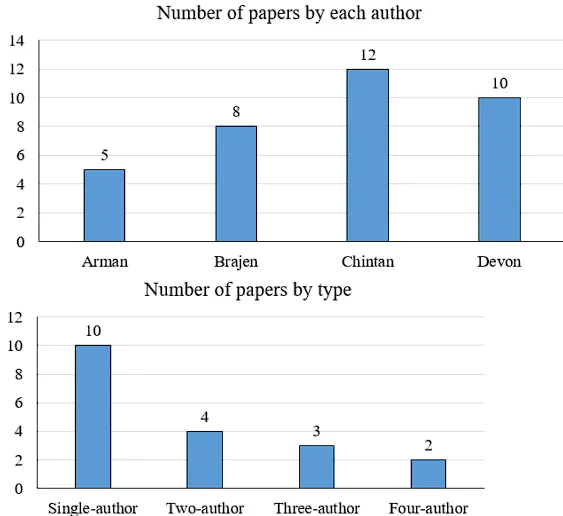
The following additional facts are known.
1. Each of the authors wrote at least one of each of the four types of papers.
2. The four authors wrote different numbers of single-author papers.
3. Both Chintan and Devon wrote more three-author papers than Brajen.
4. The number of single-author and two-author papers written by Brajen were the same.
Which of the following statements is/are NECESSARILY true?
i. Chintan wrote exactly three two-author papers.
ii. Chintan wrote more single-author papers than Devon
Correct Answer :
Neither i nor ii
Solution :
The correct answer is Neither i nor ii.
To determine the validity of the statements, we must first extract the specific data points visible in the provided charts.
From Chart 1 (Total Papers by Author), we identify the following labels and values:
Arman: 14
Brajen: 8
Chintan: 13
Devon: 15
From Chart 2 (Total Papers of Each Type), we extract the following data points:
Single-author: 10
Two-author: 7
Three-author: 6
Four-author: 2
Now, let us break down the logical deductions step-by-step:
Step 1: Four-Author Papers
There are exactly 2 four-author papers. By definition, a four-author paper involves all four authors. Therefore, every author (Arman, Brajen, Chintan, and Devon) wrote exactly 2 four-author papers.
Step 2: Single-Author Papers
There is a total of 10 single-author papers. The rules state that each author wrote at least one of each type, and they all wrote a different number of single-author papers. The only set of four different positive integers that sums to 10 is:
This is because:
Thus, the single-author paper counts for the four authors must be 1, 2, 3, and 4 in some order.
Step 3: Brajen's Distribution
Brajen wrote a total of 8 papers. We already established he wrote 2 four-author papers. This leaves 6 papers distributed among the remaining three types.
The facts state that Brajen wrote the same number of single-author and two-author papers. Let this number be denoted as:
Because he must write at least one of each type, his three-author papers can be expressed as:
If he wrote 1 single-author paper, then he wrote 1 two-author paper and 4 three-author papers. However, the rules state both Chintan and Devon wrote more three-author papers than Brajen. If Brajen wrote 4, Chintan and Devon must write at least 5 each. This would cause the total number of three-author participations to exceed the mathematically possible maximum. Therefore, Brajen must have written exactly 2 single-author papers.
This means Brajen wrote 2 single-author, 2 two-author, 2 three-author, and 2 four-author papers.
Consequently, the single-author counts for Arman, Chintan, and Devon must be a permutation of the remaining numbers:
Step 4: Testing the Statements
The question asks if the following statements are necessarily true:
i. Chintan wrote exactly three two-author papers.
ii. Chintan wrote more single-author papers than Devon.
To prove they are not necessarily true, we can construct valid scenarios that satisfy all conditions but yield varying results.
Scenario A:
Let the single-author papers for Arman, Chintan, and Devon be 4, 1, and 3 respectively.
Let their three-author papers be 4, 6, and 6 respectively. This is valid because the total three-author participations equal 18 (Arman's 4 + Brajen's 2 + Chintan's 6 + Devon's 6).
We can deduce Chintan's two-author papers by subtracting his other papers from his total of 13:
In this perfectly valid scenario, Chintan wrote 4 two-author papers, making Statement i false. Furthermore, Chintan wrote 1 single-author paper while Devon wrote 3, making Statement ii false.
Scenario B:
Let the single-author papers for Arman, Chintan, and Devon be 3, 4, and 1 respectively.
Let their three-author papers be 6, 5, and 5 respectively. (Total participations = 6 + 2 + 5 + 5 = 18).
We deduce Chintan's two-author papers by subtracting from his total:
In this valid scenario, Chintan wrote 2 two-author papers, meaning Statement i is false again. Here, Chintan wrote 4 single-author papers compared to Devon's 1, meaning Statement ii happens to be true.
Conclusion:
Because the distribution of these papers can vary while still perfectly satisfying all the given facts and chart data, neither of the specific claims in statement i or statement ii holds true in every possible valid configuration. Therefore, neither statement is necessarily true.
Access expert-curated educational resources and study materials—completely free.
Create, conduct, and manage professional online assessments with Mindyard. Perfect for teachers and institutes.
Copyright © 2026 Mindyard. All Rights Reserved.




