
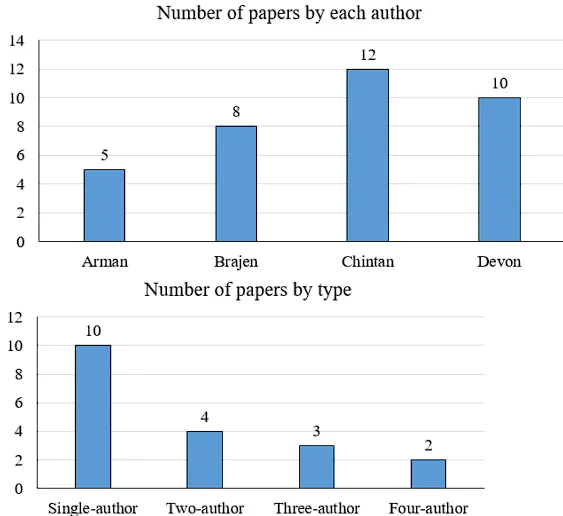
The following charts depict details of research papers written by four authors, Arman, Brajen, Chintan, and Devon.
The papers were of four types, single-author, two-author, three-author, and four-author, that is, written by one, two, three, or all four of these authors, respectively. No other authors were involved in writing these papers.
The following additional facts are known.
1. Each of the authors wrote at least one of each of the four types of papers.
2. The four authors wrote different numbers of single-author papers.
3. Both Chintan and Devon wrote more three-author papers than Brajen.
4. The number of single-author and two-author papers written by Brajen were the same.
Which of the following statements is/are NECESSARILY true?
i. Arman wrote three-author papers only with Chintan and Devon. ii. Brajen wrote three-author papers only with Chintan and Devon.
Correct Answer :
Both i and ii
Solution :
The correct answer is Both i and ii.
From the image/charts provided, we can extract the following data points regarding the total number of papers written by the authors and the total number of four-author papers. Specifically, the charts show Arman wrote a total of 5 papers, Brajen wrote a total of 8 papers, and there were exactly 2 four-author papers. Because a four-author paper involves all four authors by definition, this means every single author has exactly 2 four-author papers to their name.
Let us denote the number of single-author, two-author, three-author, and four-author papers written by an author using the subscripts 1, 2, 3, and 4 respectively. For example, let , , , and represent the number of papers of each type written by Arman. Similarly, we use for Brajen, for Chintan, and for Devon.
Based on the given facts, we know:
Fact 1: Every author wrote at least one of each type of paper. Thus, the value for any paper category for any author is at least 1.
From the chart data, we established that:
For Arman, the total number of papers is 5. Therefore:
Substituting , we get:
Since each value must be at least 1, the only possible mathematical solution is:
, , and
Now, let's look at Brajen. The total number of papers for Brajen is 8. Therefore:
Substituting , we get:
According to Fact 4, the number of single-author and two-author papers written by Brajen were the same. Thus, . Substituting this into the equation yields:
Since and must be integers greater than or equal to 1, the possible values for are 1 or 2. (If , then , which violates Fact 1).
However, Fact 2 states that all four authors wrote different numbers of single-author papers. We already found that Arman wrote 1 single-author paper (). Therefore, Brajen cannot also have 1 single-author paper, meaning cannot be 1. This logically leaves only one option:
If , then , and we can easily solve for :
So, Brajen wrote exactly 2 three-author papers.
Next, we determine the total number of three-author papers across all authors. Let be this total number. Each three-author paper has exactly 3 authors. Therefore, the sum of the three-author papers credited to each individual author must equal three times the total number of three-author papers. Mathematically, this is expressed as:
Substituting the values we know ( and ):
According to Fact 3, both Chintan and Devon wrote more three-author papers than Brajen. Since , this means:
and
Furthermore, an individual author logically cannot write more three-author papers than the total number of three-author papers that exist. Therefore, and . This means their sum is bound by:
Substituting this inequality back into our main equation gives:
Subtracting from both sides, we deduce that:
We already established that Chintan wrote at least 3 three-author papers (). Since he cannot write more papers than exist in total (), it must also be true that .
Combining and , the total number of three-author papers must be exactly 3:
Since , and both Chintan and Devon wrote at least 3 of these papers but cannot write more than 3, they both must have written exactly 3 three-author papers. Thus, and .
Because there are exactly 3 three-author papers in total, and both Chintan and Devon are credited with 3 three-author papers, Chintan and Devon MUST be co-authors on ALL three of the three-author papers.
Since every three-author paper requires exactly three authors, the first two authors are always Chintan and Devon. The third author on each paper must be either Arman or Brajen to make up the trio.
We know Arman wrote exactly 1 three-author paper. This paper must therefore be co-authored by Arman, Chintan, and Devon.
We know Brajen wrote exactly 2 three-author papers. These two papers must therefore be co-authored by Brajen, Chintan, and Devon.
Now let's evaluate the given statements with these logically proven facts:
Statement i: Arman wrote three-author papers only with Chintan and Devon.
This is necessarily true. Arman's single three-author paper was co-authored exclusively with Chintan and Devon.
Statement ii: Brajen wrote three-author papers only with Chintan and Devon.
This is necessarily true. Both of Brajen's three-author papers were co-authored exclusively with Chintan and Devon.
Since both conditions hold perfectly under all constraints and data points, both statements are necessarily correct.
Access expert-curated educational resources and study materials—completely free.
Create, conduct, and manage professional online assessments with Mindyard. Perfect for teachers and institutes.
Copyright © 2026 Mindyard. All Rights Reserved.




