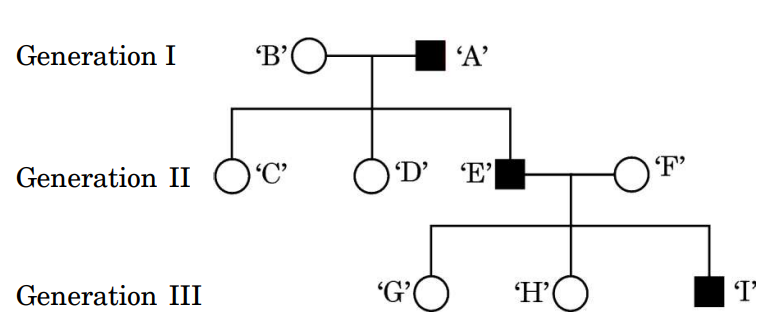
The following pedigree chart shows the inheritance of a genetic disorder up to three generations of a family. Observe the chart and answer the questions that follow.
(i) Is the disease sex-linked or autosomal as per the chart ? Give reasons in support of your answer.
(ii) Is it a recessive or a dominant disorder?
(iii) Write the genotypes of the individuals 'C', 'D' and 'H'.
(iv) a) If the female 'D' marries a normal man, what will be the probability of their daughter being a sufferer of this disease ?
or
b) If the mother 'B' is a carrier of the disease, what will be the probability of their daughter being a sufferer of this disease ?
Correct Answer :
(i)
• Sex linked disorder
• More males are affected in the family as males have only one X chromosome which if affected expresses
(ii) Recessive disorder
(iii) C -XXᶜ; D- XXᶜ; H- XXᶜ ‘c’ is affected allele, accept other symbols used for the same
(iv)
a) Probability 0%
or
b) Probability-50%
Solution :
Based on the pedigree chart provided in the image, the correct answers are:
(i) Sex-linked disorder. More males are affected in the family as males have only one X chromosome which, if affected, expresses the disease.
(ii) Recessive disorder.
(iii) Genotypes: C - ; D - ; H - (where is the affected allele).
(iv) a) Probability 0% or b) Probability 50%.
Step-by-Step Educational Explanation:
(i) Determining Sex-linked vs. Autosomal Inheritance:
Looking closely at the pedigree chart, we can observe the affected individuals who are represented by shaded square symbols:
• Generation I: Individual 'A' (affected male)
• Generation II: Individual 'E' (affected male)
• Generation III: Individual 'I' (affected male)
All affected individuals in this pedigree are males. Males have only one X chromosome (genotype ). In a sex-linked (specifically X-linked) recessive disorder, a single copy of the mutated allele on the X chromosome is sufficient to cause the disease in males because they lack a second X chromosome to mask it. Females, having two X chromosomes (), require two copies of the affected allele to show symptoms, making them carriers if they have only one. The high prevalence of affected males supports a sex-linked disorder.
(ii) Determining Dominant vs. Recessive Nature:
The disorder is recessive. We can prove this by looking at individual 'E' (affected father, genotype ) and individual 'F' (unaffected mother, genotype or ). Their son, individual 'I', is affected. Since a male inherits his Y chromosome from his father ('E') and his X chromosome from his mother ('F'), individual 'I' must have received the affected X chromosome () from his unaffected mother 'F'. Since mother 'F' carries the disease allele but does not show symptoms, the disease allele must be recessive to the normal allele.
(iii) Determining Genotypes:
Let represent the X chromosome carrying the recessive affected allele and represent the X chromosome carrying the normal dominant allele.
• Individual 'C': Since her father 'A' is affected (), he must pass his only X chromosome () to all of his daughters. Since 'C' is an unaffected female, she must have received a normal X chromosome from her mother 'B'. Therefore, her genotype is .
• Individual 'D': Like her sister 'C', she is an unaffected daughter of the affected father 'A' (). She also inherits from her father and a normal from her mother 'B', resulting in the genotype .
• Individual 'H': She is an unaffected daughter of the affected father 'E' (). She must inherit her father's chromosome and a normal chromosome from her mother 'F'. Thus, her genotype is .
(iv) Probability Analysis:
Case a) If female 'D' marries a normal man:
• Female 'D' genotype: (carrier)
• Normal male genotype:
Let us perform the genetic cross:
The possible genotypes of their daughters are:
• (normal female)
• (carrier, unaffected female)
Since none of the daughters have the genotype , the probability of their daughter being a sufferer of this disease is 0%.
Case b) If mother 'B' is a carrier of the disease:
• Mother 'B' genotype: (carrier)
• Father 'A' genotype: (affected)
Let us perform the genetic cross:
The possible genotypes of their daughters are:
• (carrier, unaffected female) - 50% probability among daughters
• (affected female) - 50% probability among daughters
Therefore, the probability of their daughter being a sufferer of this disease is 50%.
Access expert-curated educational resources and study materials—completely free.
Create, conduct, and manage professional online assessments with Mindyard. Perfect for teachers and institutes.
Copyright © 2026 Mindyard. All Rights Reserved.
 Set - 3-1782888548748.webp)