
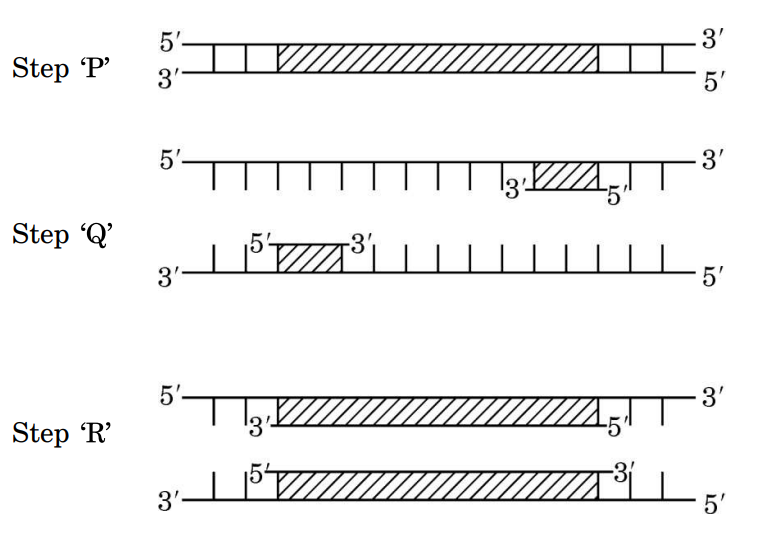
The given schematic illustration shows three steps 'P', 'Q' and 'R' of the polymerase chain reaction. Which of the following statements are correct with reference to the illustration given above ?
(i) Step is showing denaturation at low temperature.
(ii) Step is a denaturation of DNA strand at high temperature, followed by annealing.
(iii) Step is an extension of DNA in presence of thermostable DNA polymerase.
(iv) Step is extension with two sets of primers.
Solution :
The correct option is (ii) and (iii) only.
Detailed Explanation:
The given schematic illustration depicts the three fundamental steps of the Polymerase Chain Reaction (PCR), which is a technique used to amplify a specific segment of DNA. These steps are labeled as 'P', 'Q', and 'R' in the image:
1. Step 'P' — Denaturation:
In this initial step, the double-stranded template DNA shown in Step 'P' is heated to a high temperature (approximately 94°C to 96°C). The heat breaks the hydrogen bonds between the complementary base pairs, separating the double-stranded DNA into two single-stranded templates.
• Statement (i) is incorrect because denaturation occurs at high temperature, not low temperature.
• Statement (ii) is correct because Step 'P' represents denaturation at high temperature, which is followed by the annealing stage (Step 'Q').
2. Step 'Q' — Annealing:
In Step 'Q', the temperature is lowered (typically to 50°C–65°C) to allow two sets of synthetic oligonucleotide primers to bind (anneal) to their complementary sequences at the 3' ends of the separated single-stranded DNA templates.
3. Step 'R' — Extension (Elongation):
In Step 'R', the temperature is raised to about 72°C. A thermostable DNA polymerase (commonly Taq polymerase, isolated from the bacterium Thermus aquaticus) synthesizes new complementary strands by adding deoxyribonucleoside triphosphates (dNTPs) to the 3'-OH ends of the primers.
• Statement (iii) is correct because Step 'R' represents the extension of DNA strands facilitated by a thermostable DNA polymerase.
• Statement (iv) is incorrect because Step 'R' is the extension phase, whereas the two sets of primers are added and annealed during the annealing step (Step 'Q').
Therefore, statements (ii) and (iii) are correct, making (ii) and (iii) only the correct answer.
Completely free for students. Educators & coaching institutes get 2 months free Pro trial to create tests.
Access unlimited practice questions, detailed step-by-step solutions, and exam study materials — completely free for students.
Create and conduct professional online assessments with AI question generation, tab proctoring, and comprehensive batch management.

Prepare effectively with the CBSE Class 12 Biology 2022–23 Set - 1 Question Paper. This paper is ideal for students appearing for the CBSE Class 12 Board Examination and helps in understanding the latest exam pattern, question types, and marking scheme. Practice with authentic board-level questions to improve accuracy, time management, and conceptual clarity. The paper includes detailed solutions to help you analyze your performance and strengthen important Biology concepts before the exam.

Practice with the CBSE Class 12 Biology 2022–23 Set - 2 Question Paper to strengthen your preparation for the CBSE Board Examination. This previous year question paper follows the latest CBSE exam pattern and includes a variety of board-level questions covering Genetics, Evolution, Biotechnology, Human Physiology, Reproduction, Ecology, and other important topics. Detailed solutions help you understand the correct approach, improve conceptual clarity, and enhance time management for the final exam. Solving this paper is an excellent way to evaluate your preparation and boost your confidence before the board examination.
Copyright © 2026 Combe Labs Private Limited. All Rights Reserved.
 Set - 3-1782888548748.webp)

