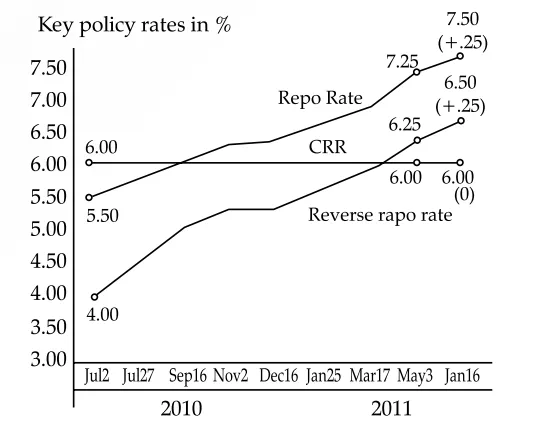
The graph given below indicates the changes in key policy rates made by the Central Bank several times in a year:
Which one of the following can be the most likely reason for the Central Bank for such an action?
Correct Answer :
Anti-inflationary stance
Solution :
The correct option is Anti-inflationary stance.
Graph Analysis and Key Observations:
By examining the provided graph titled "Key policy rates in %", we can observe the following trends from July 2010 to January 2011:
1. Repo Rate: This rate steadily increases from
in July 2010 to
in January 2011, representing a total increase of
(or 200 basis points).
2. Reverse Repo Rate: This rate rises from
in July 2010 to
in January 2011, showing an increase of
(or 250 basis points).
3. Cash Reserve Ratio (CRR): This remains flat at
throughout the period.
Economic Logic and Reasoning:
The Central Bank's decision to increase both the Repo Rate and the Reverse Repo Rate is a contractionary monetary policy action designed to control inflation. The mechanism works as follows:
Repo Rate: The Repo Rate is the interest rate at which the central bank lends money to commercial banks. Raising this rate makes borrowing expensive for commercial banks, which in turn increases their lending rates for businesses and consumers. This discourages borrowing and dampens aggregate demand in the economy.
Reverse Repo Rate: The Reverse Repo Rate is the interest rate at which the central bank borrows money from commercial banks. An increase in this rate encourages commercial banks to park more funds with the central bank for secure returns rather than lending them to the public, which directly reduces the money supply in circulation.
Conclusion:
Since the primary purpose of increasing these policy rates is to reduce credit expansion, lower consumer demand, and absorb excess money from the financial system to control rising prices, this action directly corresponds to an anti-inflationary stance.
Access expert-curated educational resources and study materials—completely free.
Create, conduct, and manage professional online assessments with Mindyard. Perfect for teachers and institutes.
Copyright © 2026 Mindyard. All Rights Reserved.