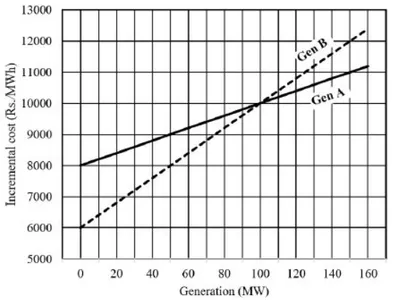
The incremental cost curves of two generators (Gen A and Gen B) in a plant supplying a common load are shown in the figure. If the incremental cost of supplying the common load is Rs. 7400 per MWh, then the common load in MW is __________ (rounded off to the nearest integer).
Correct Answer :
Solution :
The correct answer is 35.
To find the common load supplied by the two generators, we first need to determine the incremental cost (IC) equations for both Gen A and Gen B from the given graph.
1. Incremental Cost Equation for Generator A (Solid Line):
From the graph, the solid line for Gen A has the following points:
- At , the incremental cost is .
- At , the incremental cost is .
The slope of the line for Gen A is:
Thus, the incremental cost equation for Gen A is:
2. Incremental Cost Equation for Generator B (Dashed Line):
From the graph, the dashed line for Gen B has the following points:
- At , the incremental cost is .
- At , the incremental cost is .
The slope of the line for Gen B is:
Thus, the incremental cost equation for Gen B is:
3. Determining the Generation under Optimal Dispatch:
For optimal distribution of load, the incremental costs of the operating generators must equal the incremental cost of supplying the common load ().
Given that the incremental cost of supplying the common load is:
Let's analyze the contribution of each generator:
- For Gen A, the minimum incremental cost (when ) is . Since the required incremental cost of the system is (which is less than ), Generator A cannot economically supply any power and operates at its lower limit:
- For Gen B, the generator operates at the incremental cost of the load:
Solving for :
4. Total Common Load:
The total common load () is the sum of the power generated by both Gen A and Gen B:
Access expert-curated educational resources and study materials—completely free.
Create, conduct, and manage professional online assessments with Mindyard. Perfect for teachers and institutes.
Copyright © 2026 Mindyard. All Rights Reserved.