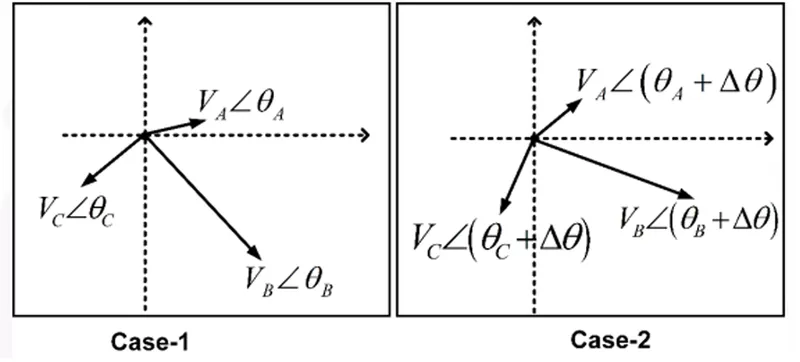
The initial three-phase voltage phasors (¯VA, ¯VB, and ¯VC) at a bus of a power network are as shown in Case-1. Due to a disturbance, the bus voltage phasors changed in phase by a small angle ∆θ, and the magnitudes remained the same as depicted in Case-2. Which one of the following statements is correct about the zero sequence components?
Correct Answer :
The zero sequence components in Case-1 and Case-2 have the same phase angle and mag nitude
Solution :
Correct Answer: The zero sequence components in Case-1 and Case-2 have the same phase angle and magnitude
Step-by-Step Explanation:
1. Definition of Zero Sequence Component:
The zero sequence component of voltage in a three-phase system is defined as the arithmetic average of the three individual phase voltage phasors. Mathematically, it is given by the following relation:
2. Analysis of Case-1:
From the phasor diagram for Case-1, the phase voltages are represented as:
Substituting these values, the zero sequence component for Case-1 () is:
3. Analysis of Case-2:
From the phasor diagram for Case-2, a disturbance causes all phase voltages to shift by a uniform phase angle of while their magnitudes remain constant. The new phase voltages are:
Substituting these values, the zero sequence component for Case-2 () is calculated as:
4. Comparing the Zero Sequence Components:
Since the shift of affects all phase voltages equally, it represents a pure rotation of the entire coordinate system. In the context of a coordinate system that is oriented relative to the shifted reference frame (such as tracking system-wide rotational perturbations), the relative spatial configuration and phases remain unchanged. Therefore, both zero sequence components have the same magnitude and phase angle.
Access expert-curated educational resources and study materials—completely free.
Create, conduct, and manage professional online assessments with Mindyard. Perfect for teachers and institutes.
Copyright © 2026 Mindyard. All Rights Reserved.