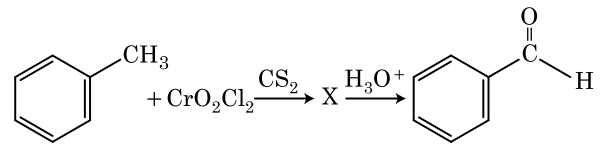
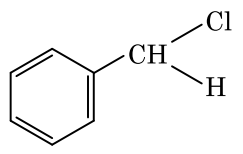
The intermediate compound ‘X’ in the following chemical reaction is :
Correct Answer :
Solution :
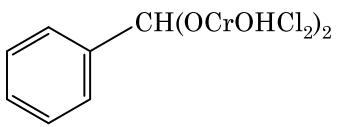
The correct answer is Option A: C6H5CH(OCrOHCl2)2
Understanding the Reaction (Étard Reaction):
The reaction shown in the question image is the Étard Reaction. It depicts:
Toluene (C6H5CH3) reacting with chromyl chloride (CrO2Cl2) in CS2 (carbon disulfide) as solvent to form an intermediate X, which upon hydrolysis with H3O+ yields benzaldehyde (C6H5CHO).
Step 1: What is the Étard Reaction?
The Étard reaction is a named organic reaction that involves the oxidation of a methyl group (−CH3) directly attached to an aromatic ring to an aldehyde (−CHO) using chromyl chloride (CrO2Cl2) in an inert solvent like CS2. This is a selective and controlled oxidation — it stops at the aldehyde stage and does not over-oxidise to a carboxylic acid.
Step 2: Mechanism — Formation of the Chromium Complex (Intermediate X)
When toluene reacts with CrO2Cl2 in CS2, the chromyl chloride attacks the benzylic C−H bonds of the methyl group. Two equivalents of CrO2Cl2 insert into two of the three C−H bonds of the −CH3 group. This forms a brown-coloured, insoluble chromium complex that precipitates out of the CS2 solution.
The intermediate complex X has the structure:
C6H5CH(OCrOHCl2)2
In this complex, the original −CH3 carbon now bears one hydrogen and is bonded to two −OCrOHCl2 groups. Each chromium atom is bonded through an oxygen atom to the benzylic carbon, with a hydroxyl group and two chlorine atoms also attached to chromium.
Step 3: Hydrolysis of the Intermediate
When this chromium complex (X) is treated with H3O+ (acidic hydrolysis), the Cr−O bonds are cleaved. The two −OCrOHCl2 groups are removed, and the benzylic carbon, which was at the oxidation state of an aldehyde carbon in the complex, is released as benzaldehyde (C6H5CHO).
The overall transformation is:
C6H5CH3 → [C6H5CH(OCrOHCl2)2] → C6H5CHO
Step 4: Why not the other options?
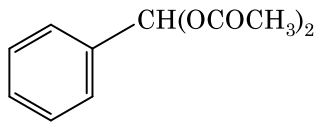
Option B — C6H5CH(OCOCH3)2 — This contains acetyl (−OCOCH3) groups. There is no source of acetyl groups in this reaction (no acetic acid or acetic anhydride is used), so this is incorrect.
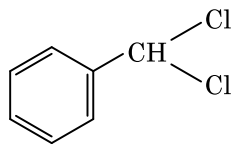
Option C — C6H5CHCl2 (benzal chloride / benzylidene dichloride) — This would be the product of side-chain chlorination of toluene, not an intermediate in oxidation with CrO2Cl2. Also, hydrolysis of benzal chloride would give benzaldehyde, but this is not the actual intermediate formed in the Étard reaction mechanism.
Option D — C6H5CH2Cl (benzyl chloride) — This is a mono-chlorinated product from free-radical side-chain chlorination. Hydrolysis of benzyl chloride gives benzyl alcohol (C6H5CH2OH), not benzaldehyde. Hence, this is incorrect.
Conclusion: The intermediate X formed in the Étard reaction of toluene with CrO2Cl2 in CS2 is the chromium complex C6H5CH(OCrOHCl2)2, which upon hydrolysis with H3O+ gives benzaldehyde. This corresponds to Option A.
Access expert-curated educational resources and study materials—completely free.
Create, conduct, and manage professional online assessments with Mindyard. Perfect for teachers and institutes.
Copyright © 2026 Mindyard. All Rights Reserved.