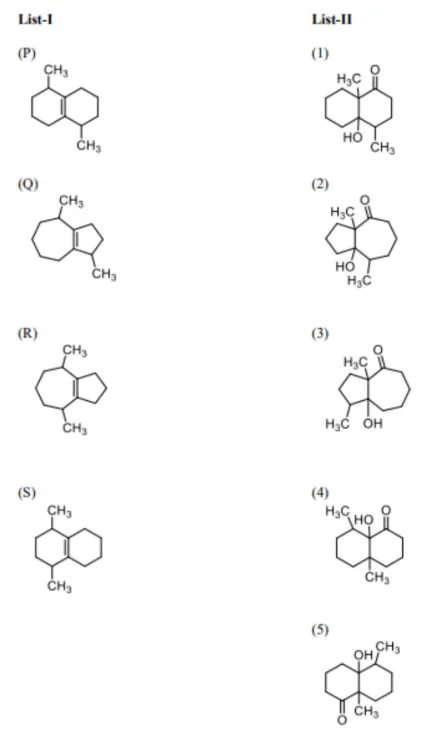
The List-I contains products obtained from the reaction of compounds in List-I with O3/Zn−H2O followed by cyclization (via more stable enolate) in the presence of aqueous NaOH. Match each entry in List-I with appropriate entry in List-II and choose the correct option.
Correct Answer :
P → 3; Q → 4; R → 5; S → 2
Solution :
Correct Answer: P → 3; Q → 4; R → 5; S → 2
Step-by-Step Explanation:
The reaction involves two sequential steps:
1. Ozonolysis (O3/Zn-H2O): Reductive cleavage of the central carbon-carbon double bond (C=C) to form a diketone (or dicarbonyl compound).
2. Intramolecular Aldol Condensation (via aqueous NaOH): Deprotonation to form the more stable enolate (more substituted enolate), which undergoes nucleophilic attack on the other carbonyl group to form a cyclic β-hydroxy ketone (aldol addition product).
Let's analyze each starting compound in List-I:
1. Entry (P):
The starting alkene in (P) consists of two fused 6-membered rings (bicyclic [4.4.0] system) with methyl groups on positions adjacent to the double bond on opposite sides (1,6-dimethyl-bicyclo[4.4.0]dec-1-ene system).
• Ozonolysis cleaves the central alkene bond to yield a 10-membered ring containing two carbonyl groups (dione) with methyl substituents.
• Treatment with aqueous NaOH generates the more stable enolate by removing a proton from the more substituted α-position (the α-carbon bearing the methyl group).
• Intramolecular attack of this enolate onto the remaining carbonyl group forms a fused bicyclic system consisting of a 5-membered ring and a 7-membered ring containing a hydroxyl (-OH) group and a carbonyl (C=O) group, matching structure (3) in List-II.
Therefore, P → 3.
2. Entry (Q):
The starting alkene in (Q) consists of a 7-membered ring fused to a 5-membered ring (bicyclo[5.3.0]dec-1-ene system) with methyl groups.
• Ozonolysis cleaves the double bond to form a dicarbonyl intermediate.
• Formation of the more stable enolate followed by aldol cyclization leads to a bicyclic compound containing a 6-membered ring fused to another 6-membered ring system, matching structure (4) in List-II.
Therefore, Q → 4.
3. Entry (R):
The starting alkene in (R) has a 7-membered ring fused to a 5-membered ring with a different methyl substitution pattern than Q.
• Cleavage via ozonolysis gives the corresponding open-chain/macrocyclic dicarbonyl intermediate.
• Deprotonation gives the thermodynamically favored, more substituted enolate, which undergoes intramolecular nucleophilic attack on the carbonyl carbon to form a 6,6-bicyclic β-hydroxy ketone structure corresponding to (5) in List-II.
Therefore, R → 5.
4. Entry (S):
The starting compound in (S) is a symmetrical bicyclo[4.4.0]dec-1-ene derivative with two methyl groups on the same side of the double bond.
• Ozonolysis cleaves the C=C bond to give a symmetrical 1,6-dione intermediate.
• Deprotonation at the more substituted α-carbon gives the more stable enolate, which attacks the second carbonyl carbon to form a 5,7-fused bicyclic ring system containing the β-hydroxy ketone motif, corresponding to structure (2) in List-II.
Therefore, S → 2.
Conclusion:
Matching the entries gives:
P → 3, Q → 4, R → 5, S → 2
Access expert-curated educational resources and study materials—completely free.
Create, conduct, and manage professional online assessments with Mindyard. Perfect for teachers and institutes.
Copyright © 2026 Mindyard. All Rights Reserved.