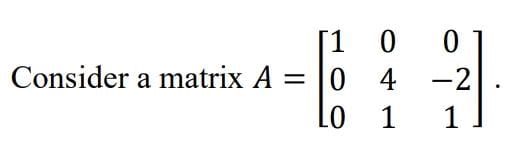
The matrix A satisfies the equation 6A-1=A2+cA+dl where c and d are scalars and I is the identity matrix. Then (c+d) is equal to
Correct Answer :
5
Solution :
The correct option is 5.
From the given image, we identify the matrix as follows:
To find the characteristic equation of matrix , we compute the determinant :
Expanding the determinant along the first row:
Multiplying the equation by gives the characteristic equation:
By the Cayley-Hamilton Theorem, matrix satisfies its own characteristic equation:
where is the identity matrix and is the zero matrix.
Rearranging the equation to solve for the identity term:
Since the determinant of is non-zero, is invertible. Multiplying both sides by :
Comparing this with the given equation:
By comparing the coefficients, we obtain:
Thus, we compute the sum :
Access expert-curated educational resources and study materials—completely free.
Create, conduct, and manage professional online assessments with Mindyard. Perfect for teachers and institutes.
Copyright © 2026 Mindyard. All Rights Reserved.