
The most stable carbocation among the following is :
Options
 .
 .
 .
 .
.Solution :
To determine the most stable carbocation among the given options, we can analyze the degree of carbocation (primary, secondary, or tertiary) and the factors stabilizing them, such as inductive effect (+I effect) and hyperconjugation (number of -hydrogens).
Let's analyze the structure of each option based on the provided images:
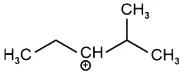
1. Option 1 (Image 0):
The carbocation is .
- The positively charged carbon is bonded to two other carbon atoms, making it a secondary (2°) carbocation.
- The neighboring carbons are a group (having 2 -hydrogens) and a group (having 1 -hydrogen).
- Total number of -hydrogens = 2 + 1 = 3.
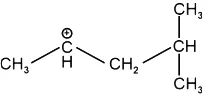
2. Option 2 (Image 1):
The carbocation is .
- The positively charged carbon is bonded to two other carbon atoms, making it a secondary (2°) carbocation.
- The neighboring carbons are a group (having 3 -hydrogens) and a group (having 2 -hydrogens).
- Total number of -hydrogens = 3 + 2 = 5.
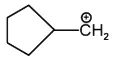
3. Option 3 (Image 2):
The carbocation is a cyclopentylmethyl carbocation (a cyclopentyl ring with a group attached).
- The positively charged carbon is bonded to only one other carbon atom, making it a primary (1°) carbocation.
- The neighboring carbon on the ring is a group, which has 1 -hydrogen.
- Total number of -hydrogens = 1.
4. Option 4 (Image 3):
The carbocation is 1-methylcyclohexyl carbocation (a cyclohexyl ring with a methyl group and the positive charge on the same carbon, carbon-1).
- The positively charged carbon is bonded to three other carbon atoms (two ring carbons and one methyl carbon), making it a tertiary (3°) carbocation.
- The neighboring carbons are a methyl group (3 -hydrogens) and two ring groups (2 + 2 = 4 -hydrogens).
- Total number of -hydrogens = 3 + 4 = 7.
Conclusion:
Since stability of carbocations follows the order:
The tertiary (3°) carbocation shown in Option 4 is the most stable carbocation due to the greatest inductive effect (+I effect) from three alkyl groups and the maximum number of hyperconjugation structures (stabilized by 7 -hydrogens).
Completely free for students. Educators & coaching institutes get 2 months free Pro trial to create tests.
Access unlimited practice questions, detailed step-by-step solutions, and exam study materials — completely free for students.
Create and conduct professional online assessments with AI question generation, tab proctoring, and comprehensive batch management.

A comprehensive JEE Advanced 2022 Paper 1 designed to help aspirants understand the examination pattern, difficulty level, and question trends of JEE Advanced. This paper covers important concepts from Physics, Chemistry, and Mathematics, featuring a balanced mix of conceptual, numerical, and advanced application-based questions. It helps students strengthen conceptual understanding, enhance analytical and problem-solving skills, and improve speed and accuracy. Ideal for practice, revision, self-assessment, previous year trend analysis, concept reinforcement, and time management, this paper is a valuable resource for effective JEE Advanced preparation.

A comprehensive JEE Advanced 2022 Paper 2 designed to help aspirants understand the examination pattern, difficulty level, and question trends of JEE Advanced. This paper covers important concepts from Physics, Chemistry, and Mathematics, featuring a balanced mix of conceptual, numerical, and advanced application-based questions. It helps students strengthen conceptual understanding, enhance analytical and problem-solving skills, and improve speed and accuracy. Ideal for practice, revision, self-assessment, previous year trend analysis, concept reinforcement, and time management, this paper is a valuable resource for effective JEE Advanced preparation.
Copyright © 2026 Combe Labs Private Limited. All Rights Reserved.


