The negative edge triggered JK flip-flop in the Figure has J and K inputs tied
to Logic High and a square wave of 10 cycles/second is applied to its clock (C)
input. The frequency of the output Q (in cycles/second) is ________ . (rounded off to two
decimal places).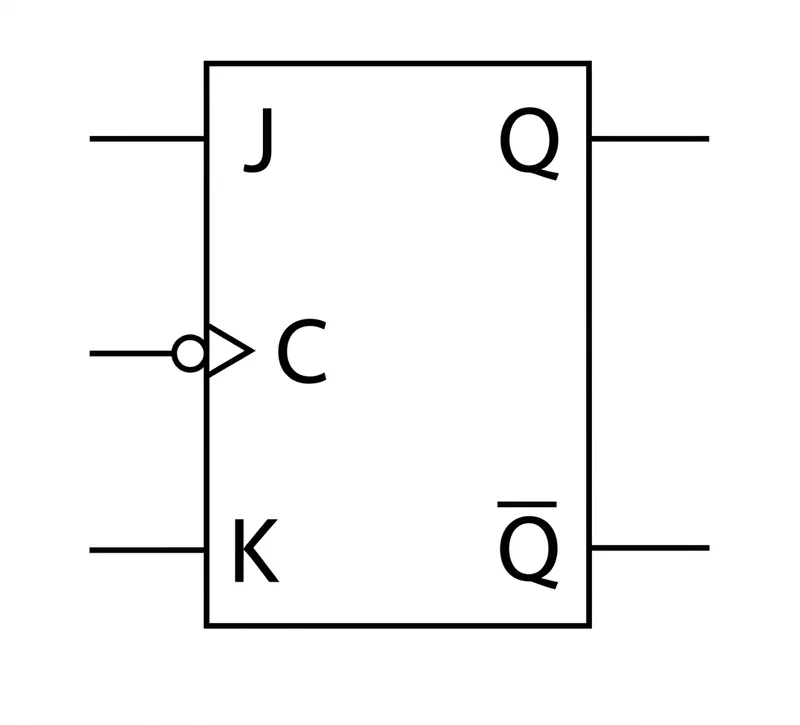
Correct Answer :
Solution :
The correct answer is 5.00.
Step 1: Analyze the flip-flop design from the provided image
The image displays a JK flip-flop with inputs labeled as J and K on the left, output terminals labeled Q and Q̅ on the right, and a clock input labeled C. The clock input C features a bubble and a triangle (dynamic indicator), which indicates that the flip-flop is triggered on the negative edge (falling edge) of the clock signal.
Step 2: Understand the behavior of the JK flip-flop in toggle mode
When both the inputs J and K are tied to logic High (that is, J = 1 and K = 1), the JK flip-flop operates in toggle mode. Under this condition, the state of the output Q toggles (changes from 0 to 1, or from 1 to 0) on every active edge of the clock signal. Because it is a negative edge triggered flip-flop, the state of Q changes exactly once on every falling edge of the clock input C.
Step 3: Relationship between input and output frequency
Since the output Q toggles on every negative edge of the clock:
- One full cycle of the clock consists of one rising edge and one falling (negative) edge.
- A change in the output Q occurs only at the negative edge.
- To complete one full cycle (going from low to high and back to low), the output Q requires two toggles, which corresponds to two negative edges of the clock.
- Therefore, two full clock cycles are needed to produce one full cycle of the output Q. This means the JK flip-flop acts as a divide-by-2 frequency divider.
The mathematical relationship between the output frequency () and the input clock frequency () is given by:
Step 4: Calculate the frequency of the output Q
We are given that the clock input has a square wave of 10 cycles/second (10 Hz). Substituting this value into the equation:
Rounding the frequency of the output Q to two decimal places, we get 5.00 cycles/second.
Access expert-curated educational resources and study materials—completely free.
Create, conduct, and manage professional online assessments with Mindyard. Perfect for teachers and institutes.
Copyright © 2026 Mindyard. All Rights Reserved.