The number of isomeric tetraenes (NOT containing sp-hybridized carbon atoms) that can be formed from the following reaction sequence is_____.
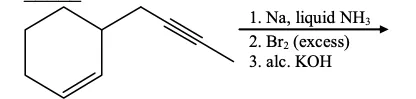
Correct Answer :
Solution :
The correct answer is 2.
To determine the number of isomeric tetraenes formed, let us break down the reaction sequence step-by-step:
Step 1: Reduction of Alkyne using Na / liquid NH3
The starting material shown in the image is 3-(but-2-yn-1-yl)cyclohex-1-ene, which contains both a ring double bond and an internal alkyne group in the side chain:
Reagent 1, sodium in liquid ammonia (), selectively reduces internal alkynes into trans-alkenes via a free-radical mechanism. The isolated double bond present in the cyclohexene ring remains unreacted. Thus, the alkyne group is converted into a trans-alkene , resulting in a diene intermediate.
Step 2: Halogenation with excess Br2
Adding excess bromine () results in electrophilic addition across both double bonds (the ring double bond and the side-chain double bond). This adds a total of 4 bromine atoms to the molecule, yielding a tetrabrominated saturated intermediate.
Step 3: Dehydrohalogenation with alcoholic KOH
Treatment with alcoholic induces elimination of 4 molecules of hydrogen bromide (). Elimination of 4 units from the 10-carbon tetrabromo derivative generates 4 double bonds (a tetraene system).
Since the problem specifies that the tetraene must NOT contain sp-hybridized carbon atoms (meaning no cumulated double bonds/allenes or alkynes are allowed, only sp2 and sp3 carbons), double bonds must be conjugated across the cyclic ring and side chain.
Considering the geometric isomers and possible conjugated double-bond positional arrangements around the 10-carbon framework without forming sp-carbons, exactly 2 isomeric tetraenes are formed.
Access expert-curated educational resources and study materials—completely free.
Create, conduct, and manage professional online assessments with Mindyard. Perfect for teachers and institutes.
Copyright © 2026 Mindyard. All Rights Reserved.