
The numbers 1, 2, 3, 4, 5, 6, 7, 8, 9, and 10 are placed in ten slots of the following grid based on the conditions below:
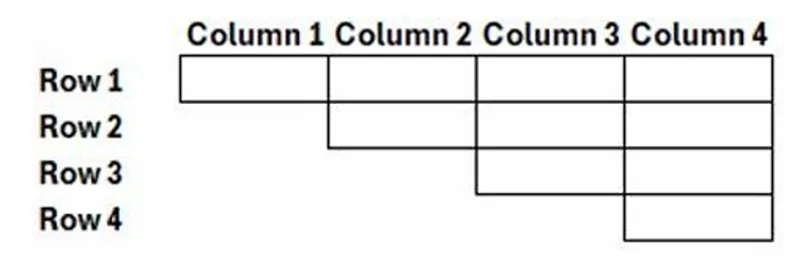
Conditions:
(a) Numbers in any row appear in an increasing order from left to right.
(b) Numbers in any column appear in a decreasing order from top to bottom.
(c) 1 is placed either in the same row or in the same column as 10.
(d) Neither 2 nor 3 is placed in the same row or in the same column as 10.
(e) Neither 7 nor 8 is placed in the same row or in the same column as 9.
(f) 4 and 6 are placed in the same row.
Which of the following statements MUST be true?
1. 2 is placed in a slot in Column 2.
2. 3 is placed in a slot in Column 3
Correct Answer :
Neither I nor II
Solution :
The correct answer is Neither I nor II.
1. Understanding the Grid Structure
Based on the provided image, we can define the coordinates of the 10 slots as (Row, Column):
• Row 1: R1C1, R1C2, R1C3, R1C4
• Row 2: R2C2, R2C3, R2C4
• Row 3: R3C3, R3C4
• Row 4: R4C4
2. Analyzing the Conditions
• Condition (a): Numbers in any row increase from left to right:
R1C1 < R1C2 < R1C3 < R1C4
R2C2 < R2C3 < R2C4
R3C3 < R3C4
• Condition (b): Numbers in any column decrease from top to bottom:
R1C2 > R2C2
R1C3 > R2C3 > R3C3
R1C4 > R2C4 > R3C4 > R4C4
From these relations, R1C4 must contain the maximum number in the grid, which is 10. Thus, 10 is placed in R1C4.
• Condition (c): 1 is in the same row or column as 10 (Row 1 or Column 4).
• Condition (d): Neither 2 nor 3 can be in Row 1 or Column 4. Since the slots not in Row 1 or Column 4 are R2C2, R2C3, and R3C3, the numbers 2 and 3 must be placed among these three slots.
3. Testing the Statements via a Counterexample
To determine if either Statement I ("2 is placed in Column 2") or Statement II ("3 is placed in Column 3") must be true, we check if there exists a valid grid arrangement where both statements are false.
Let us assign the numbers to the slots as follows:
• Row 1: R1C1 = 4, R1C2 = 6, R1C3 = 9, R1C4 = 10
• Row 2: R2C2 = 3, R2C3 = 5, R2C4 = 8
• Row 3: R3C3 = 2, R3C4 = 7
• Row 4: R4C4 = 1
Let us verify all conditions for this arrangement:
• Row increasing order: 4 < 6 < 9 < 10 (Row 1), 3 < 5 < 8 (Row 2), and 2 < 7 (Row 3). (Satisfied)
• Column decreasing order: 6 > 3 (Column 2), 9 > 5 > 2 (Column 3), and 10 > 8 > 7 > 1 (Column 4). (Satisfied)
• Condition (c): 1 is in Column 4, which contains 10. (Satisfied)
• Condition (d): Neither 2 (at R3C3) nor 3 (at R2C2) is in Row 1 or Column 4. (Satisfied)
• Condition (e): 9 is at R1C3. Its row (Row 1) and column (Column 3) contain neither 7 (at R3C4) nor 8 (at R2C4). (Satisfied)
• Condition (f): 4 (at R1C1) and 6 (at R1C2) are both in Row 1. (Satisfied)
Since this arrangement satisfies all conditions, we examine the positions of 2 and 3:
• 2 is placed in R3C3 (Column 3), so Statement I is false.
• 3 is placed in R2C2 (Column 2), so Statement II is false.
Therefore, neither statement must be true, and the correct option is Neither I nor II.
Access expert-curated educational resources and study materials—completely free.
Create, conduct, and manage professional online assessments with Mindyard. Perfect for teachers and institutes.
Copyright © 2026 Mindyard. All Rights Reserved.




