
The numbers 1, 2, 3, 4, 5, 6, 7, 8, 9, and 10 are placed in ten slots of the following grid based on the conditions below:
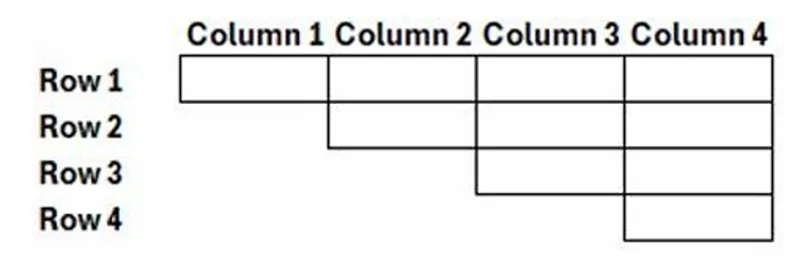
Conditions:
(a) Numbers in any row appear in an increasing order from left to right.
(b) Numbers in any column appear in a decreasing order from top to bottom.
(c) 1 is placed either in the same row or in the same column as 10.
(d) Neither 2 nor 3 is placed in the same row or in the same column as 10.
(e) Neither 7 nor 8 is placed in the same row or in the same column as 9.
(f) 4 and 6 are placed in the same row.
Which of the following statements MUST be true?
Correct Answer :
Both I and II.
Solution :
The correct option is Both I and II.
To understand why this is the case, let us analyze the grid structure and the conditions step-by-step.
Step 1: Understanding the Grid Structure
Based on the provided grid image, the slots are arranged in a staircase pattern (a Young diagram):
- Row 1 contains 4 slots: Column 1, Column 2, Column 3, and Column 4.
- Row 2 contains 3 slots: Column 2, Column 3, and Column 4.
- Row 3 contains 2 slots: Column 3 and Column 4.
- Row 4 contains 1 slot: Column 4.
Let us represent each slot as (row, column). The 10 available slots are:
Row 1: (1,1), (1,2), (1,3), (1,4)
Row 2: (2,2), (2,3), (2,4)
Row 3: (3,3), (3,4)
Row 4: (4,4)
Step 2: Applying the Ordering Rules
- Condition (a): Numbers in any row increase from left to right. This gives us:
- Condition (b): Numbers in any column decrease from top to bottom. This gives us:
Step 3: Determining the Position of 10 (Statement I)
The number 10 is the largest number in the set. Therefore, it cannot have any number larger than it in its row (to its right) or in its column (above it).
- Since row numbers increase from left to right, the maximum number in each row must be in the rightmost column (Column 4). Thus, 10 must be in Column 4.
- Since column numbers decrease from top to bottom, the maximum number in Column 4 must be at the top, which is slot (1,4).
Therefore, 10 must be placed in slot (1,4), which is in Row 1.
This proves that Statement I is true.
Step 4: Determining the Position of 1 (Statement II)
By Condition (c), 1 must be in either the same row (Row 1) or the same column (Column 4) as 10.
Let us check if 1 can be placed in Row 1:
- In Row 1, slots (1,2) and (1,3) cannot contain 1, because they must be strictly greater than the slots below them, (2,2) and (2,3) respectively, and no number can be smaller than 1.
- Since slot (1,4) contains 10, the only slot in Row 1 that could potentially contain 1 is slot (1,1). Let us show by contradiction why 1 cannot be in slot (1,1):
1. If 1 is in slot (1,1), then by Condition (d), neither 2 nor 3 can be in Row 1 or Column 4. Since (2,3) is greater than both (2,2) and (3,3), the numbers 2 and 3 must occupy the bottom-most remaining positions, which are (2,2) and (3,3). Thus, .
2. Now, consider Condition (f), which states that 4 and 6 must be placed in the same row:
- If they are in Row 1: they must be at (1,2) and (1,3). This forces the remaining three numbers (7, 8, 9) to occupy the remaining three slots in Column 4: (2,4), (3,4), and (4,4). However, this places 7, 8, and 9 in the same column, violating Condition (e) (neither 7 nor 8 can be in the same column as 9).
- If they are in Row 2: they must be at (2,3) and (2,4) (since (2,2) is occupied by 2 or 3). This requires the slots below them, (3,4) and (4,4), to be smaller than 6. But only the number 5 is available that is smaller than 6, leaving one slot unfilled. This is a contradiction.
- If they are in Row 3 or Row 4: there are not enough empty slots to place both 4 and 6 in these rows.
Consequently, 1 cannot be placed in slot (1,1).
Thus, 1 must be placed in Column 4. Since Column 4 values decrease from top to bottom, the smallest element in Column 4 must be at the very bottom, which is slot (4,4) in Row 4.
This proves that Statement II is true.
Since both Statement I and Statement II must be true, the correct choice is Both I and II.
Access expert-curated educational resources and study materials—completely free.
Create, conduct, and manage professional online assessments with Mindyard. Perfect for teachers and institutes.
Copyright © 2026 Mindyard. All Rights Reserved.




