
The numbers 1, 2, 3, 4, 5, 6, 7, 8, 9, and 10 are placed in ten slots of the following grid based on the conditions below:
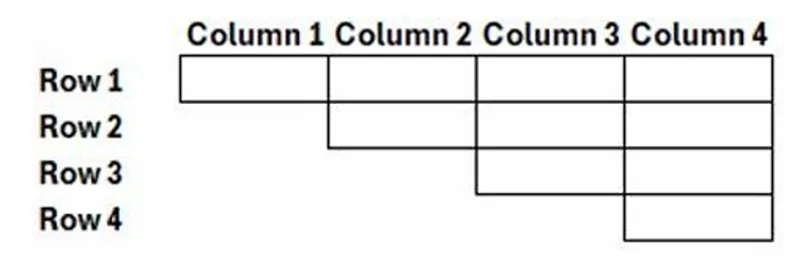
Conditions:
(a) Numbers in any row appear in an increasing order from left to right.
(b) Numbers in any column appear in a decreasing order from top to bottom.
(c) 1 is placed either in the same row or in the same column as 10.
(d) Neither 2 nor 3 is placed in the same row or in the same column as 10.
(e) Neither 7 nor 8 is placed in the same row or in the same column as 9.
(f) 4 and 6 are placed in the same row.
For howmanyslotsinthegrid, placement of numbers CANNOT be determined with certainty?
Correct Answer :
2
Solution :
The correct answer is 2.
Step-by-Step Analysis:
First, let us analyze the grid structure from the provided image:
• Row 1 has 4 slots: Column 1, Column 2, Column 3, and Column 4.
• Row 2 has 3 slots: Column 2, Column 3, and Column 4.
• Row 3 has 2 slots: Column 3 and Column 4.
• Row 4 has 1 slot: Column 4.
This forms a staircase-like grid with a total of 10 slots: 4 + 3 + 2 + 1 = 10.
Let us denote each slot by its coordinate (row, column) as follows:
• Row 1: (1,1), (1,2), (1,3), (1,4)
• Row 2: (2,2), (2,3), (2,4)
• Row 3: (3,3), (3,4)
• Row 4: (4,4)
From the given conditions:
(a) Numbers increase from left to right in any row.
(b) Numbers decrease from top to bottom in any column (so the top-most cell in a column has the largest value, and the bottom-most cell has the smallest value).
Step 1: Determine the position of 10
Since 10 is the largest number (from 1 to 10), it must be at a position that has no cells to its right (otherwise the cell to its right would have to be larger) and no cells above it. The only slot satisfying this is the top-right corner of the entire grid:
Slot (1,4) = 10.
Step 2: Determine the position of 1
Condition (c) states that 1 is placed in either the same row or the same column as 10. Since 10 is at (1,4), 1 must be placed in Row 1 or Column 4.
Since 1 is the smallest number, it must be a local minimum (having no cell to its left and no cell below it). The only local minimums in Row 1 or Column 4 are:
• Slot (1,1) (at the left end of Row 1)
• Slot (4,4) (at the bottom end of Column 4)
Let us test these two possibilities:
Case A: 1 is placed at (1,1)
If 1 is at (1,1), then by condition (d), neither 2 nor 3 can be in Row 1 or Column 4. Thus, 2 and 3 must be placed in the remaining slots of Row 2 and Row 3 that are not in Column 4, which are: {(2,2), (2,3), (3,3)}.
Since (2,3) > (2,2) and (2,3) > (3,3), 2 and 3 must be placed at (2,2) and (3,3) in some order.
By condition (f), 4 and 6 must be placed in the same row. Since (2,2) and (3,3) are occupied by 2 and 3, 4 and 6 can only be placed in Row 1 (at (1,2) and (1,3)). Therefore:
(1,2) = 4 and (1,3) = 6.
Now, since (1,3) = 6 and Column 3 must decrease downwards:
(1,3) > (2,3) > (3,3) ⇒ 6 > (2,3) > (3,3).
Since (3,3) is 2 or 3, the only possible integer value for (2,3) is 5.
This leaves 7, 8, and 9 to be placed in the remaining slots of Column 4: (2,4), (3,4), and (4,4). Since Column 4 must decrease downwards:
(2,4) = 9, (3,4) = 8, and (4,4) = 7.
However, this places 7 and 8 in the same column as 9, which violates condition (e) (neither 7 nor 8 can be in the same row or column as 9). Thus, Case A is invalid.
Case B: 1 is placed at (4,4)
If 1 is at (4,4), then 2 and 3 must still be in {(2,2), (2,3), (3,3)}. Since (2,2) and (3,3) must contain 2 and 3 in some order to preserve column/row order constraints:
• If 4 and 6 are placed in Row 1, they must be at (1,1) and (1,2) in that order because Row 1 is increasing. Thus, (1,1) = 4 and (1,2) = 6.
• 9 must be placed at (1,3) to satisfy condition (e) by keeping 7 and 8 out of Row 1 and Column 3.
• 7 and 8 are placed in Column 4 at (3,4) and (2,4) respectively to satisfy decreasing order: (2,4) = 8, (3,4) = 7.
• The remaining number 5 must be placed at (2,3).
Let us check this grid configuration:
Row 1: 4, 6, 9, 10
Row 2: 2/3, 5, 8
Row 3: 3/2, 7
Row 4: 1
Let us verify all conditions for this configuration:
• Row 1 (4 < 6 < 9 < 10) is increasing.
• Row 2 (2/3 < 5 < 8) is increasing.
• Row 3 (3/2 < 7) is increasing.
• Column 1 (4) is decreasing.
• Column 2 (6 > 2/3) is decreasing.
• Column 3 (9 > 5 > 2/3) is decreasing.
• Column 4 (10 > 8 > 7 > 1) is decreasing.
• 1 is at (4,4), which is in the same column as 10 (at (1,4)).
• Neither 2 nor 3 is in Row 1 or Column 4.
• 9 is at (1,3). Neither 7 (at (3,4)) nor 8 (at (2,4)) is in Row 1 or Column 3.
• 4 and 6 are in Row 1.
This is a completely valid configuration! Since (2,2) and (3,3) can be either 2 and 3 or 3 and 2, their exact placement cannot be determined with certainty.
Therefore, there are exactly 2 slots in the grid (specifically (2,2) and (3,3)) whose placement of numbers cannot be determined with certainty.
Access expert-curated educational resources and study materials—completely free.
Create, conduct, and manage professional online assessments with Mindyard. Perfect for teachers and institutes.
Copyright © 2026 Mindyard. All Rights Reserved.




