
The numbers 1, 2, 3, 4, 5, 6, 7, 8, 9, and 10 are placed in ten slots of the following grid based on the conditions below:
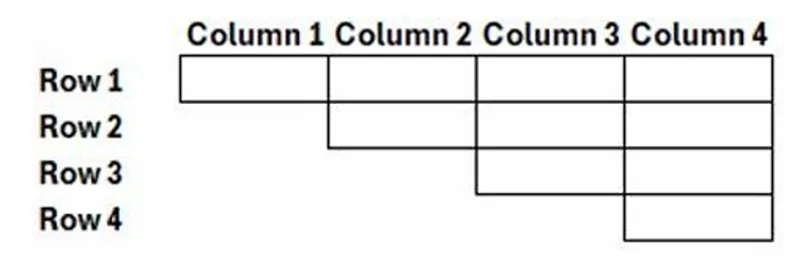
Conditions:
(a) Numbers in any row appear in an increasing order from left to right.
(b) Numbers in any column appear in a decreasing order from top to bottom.
(c) 1 is placed either in the same row or in the same column as 10.
(d) Neither 2 nor 3 is placed in the same row or in the same column as 10.
(e) Neither 7 nor 8 is placed in the same row or in the same column as 9.
(f) 4 and 6 are placed in the same row.
Whatis the row number which has the least sum of numbers placed in that row?
Correct Answer :
4
Solution :
The correct answer/option is 4 (representing Row 4).
Let us represent the cells of the grid by their coordinates , where is the row number (from 1 to 4) and is the column number (from 1 to 4). Based on the provided image:
• Row 1 contains four cells: , , , and .
• Row 2 contains three cells: , , and .
• Row 3 contains two cells: and .
• Row 4 contains one cell: .
Step 1: Finding the position of 10
By Condition (a), the numbers in any row increase from left to right. Thus, the maximum element of each row must be in its rightmost column (Column 4).
By Condition (b), the numbers in any column decrease from top to bottom. In Column 4, we have:
Since is larger than all elements in Row 1 and all elements in Column 4, it must be the largest number in the entire grid.
Therefore, 10 is placed at .
Step 2: Placing 2 and 3
According to Condition (d), neither 2 nor 3 is placed in the same row or column as 10. Since 10 is at , we cannot place 2 or 3 in Row 1 or Column 4.
This leaves only three possible cells for 2 and 3: , , and .
Applying the increasing row condition and the decreasing column condition , the cell must be larger than both and .
Therefore, the two smallest numbers, 2 and 3, must occupy and in some order.
Step 3: Determining the row containing 4 and 6
By Condition (f), 4 and 6 are placed in the same row. Since Rows 3 and 4 do not have enough cells to contain both numbers, they must be in either Row 1 or Row 2.
If 4 and 6 were placed in Row 2, the cells would be and (since is already occupied by 2 or 3). However, this would force the remaining elements to violate other conditions (such as the placement of 7, 8, and 9 under Condition (e)).
Thus, 4 and 6 must be placed in Row 1:
• 4 is placed at .
• 6 is placed at .
Step 4: Placing 1
By Condition (c), 1 must be in the same row (Row 1) or column (Column 4) as 10. Since Row 1 starts with 4, 1 cannot be in Row 1.
Therefore, 1 must be in Column 4. Since Column 4 decreases from top to bottom, the smallest element of Column 4 must be at the very bottom:
• 1 is placed at .
Step 5: Verifying the Row Sums
With the cell occupied by 1, Row 4 consists of only a single cell containing the number 1.
The sum of Row 4 is:
Since all other rows contain multiple numbers, all of which are greater than 1, their sums will be strictly greater than 1. Consequently, Row 4 is the row with the least sum of numbers.
Access expert-curated educational resources and study materials—completely free.
Create, conduct, and manage professional online assessments with Mindyard. Perfect for teachers and institutes.
Copyright © 2026 Mindyard. All Rights Reserved.




