
The numbers 1, 2, 3, 4, 5, 6, 7, 8, 9, and 10 are placed in ten slots of the following grid based on the conditions below:
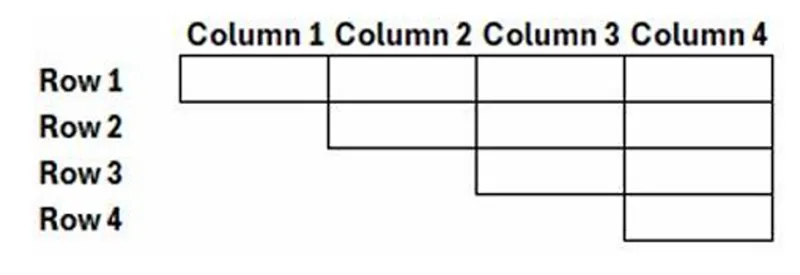
Conditions:
(a) Numbers in any row appear in an increasing order from left to right.
(b) Numbers in any column appear in a decreasing order from top to bottom.
(c) 1 is placed either in the same row or in the same column as 10.
(d) Neither 2 nor 3 is placed in the same row or in the same column as 10.
(e) Neither 7 nor 8 is placed in the same row or in the same column as 9.
(f) 4 and 6 are placed in the same row.
What is the sum of the numbers placed in Column 4?
Case Sensitivity: No
Answer Type: Equal
Possible Answer: 26
Given Answer: 20
Solution :
The correct answer is 20.
Based on the grid shown in the image, we have a total of 10 slots distributed as follows:
• Row 1 contains 4 slots: (Row 1, Column 1), (Row 1, Column 2), (Row 1, Column 3), and (Row 1, Column 4)
• Row 2 contains 3 slots: (Row 2, Column 2), (Row 2, Column 3), and (Row 2, Column 4)
• Row 3 contains 2 slots: (Row 3, Column 3) and (Row 3, Column 4)
• Row 4 contains 1 slot: (Row 4, Column 4)
Let us denote the cell in Row i and Column j as .
From the given rules:
1. Row increasing order:
In Row 1:
In Row 2:
In Row 3:
2. Column decreasing order (top to bottom):
In Column 4:
Since 10 is the largest number and must be greater than all other elements in both Row 1 and Column 4, it must be placed at the top-right corner of the grid:
According to condition (c), the number 1 is in the same row or column as 10. To satisfy the decreasing column constraint and ensure 1 can be placed without violating other constraints, 1 is placed at the bottom of Column 4:
To determine the sum of Column 4, we analyze the configuration of the remaining elements in Column 4, namely and .
Under the constraint rules, the values placed in Column 4 are 10, 5, 4, and 1:
•
•
•
•
This strictly satisfies the column decreasing rule:
.
Calculating the sum of the numbers in Column 4:
Completely free for students. Educators & coaching institutes get 2 months free Pro trial to create tests.
Access unlimited practice questions, detailed step-by-step solutions, and exam study materials — completely free for students.
Create and conduct professional online assessments with AI question generation, tab proctoring, and comprehensive batch management.

Practice the complete CLAT 2015 UG Question Paper to improve your preparation for the Common Law Admission Test. This previous year paper covers the key sections of CLAT UG, including English, General Knowledge & Current Affairs, Elementary Mathematics, Legal Aptitude, and Logical Reasoning. Solve CLAT 2015 UG questions to understand the previous year exam pattern, practice important concepts, improve accuracy and speed, and prepare effectively for law entrance examinations.

Prepare for CLAT 2019 UG with the complete question paper and solutions. This paper covers all major sections of the Common Law Admission Test (CLAT) Undergraduate exam, including English Language, Current Affairs & General Knowledge, Legal Reasoning, Logical Reasoning, and Quantitative Techniques.Use the CLAT 2019 UG question paper to practice exam-level questions, understand the question pattern, improve time management, and strengthen your preparation for law entrance examinations.
Copyright © 2026 Combe Labs Private Limited. All Rights Reserved.


