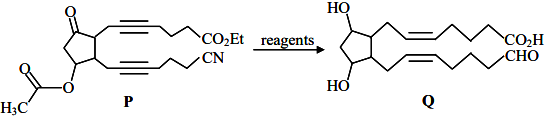
The option(s) with correct sequence of reagents for the conversion of P to Q is(are)
Correct Answer :
i) ii) iii) iv) Lindlar’s catalyst, H2
i) Lindlar’s catalyst, H2 ii) iii) iv)
Solution :
The correct sequences of reagents for the conversion of P to Q are:
Sequence 1:
i)
ii)
iii)
iv) Lindlar’s catalyst,
Sequence 2:
i) Lindlar’s catalyst,
ii)
iii)
iv)
To understand the conversion, let us look at the transformations required to convert P to Q as shown in the structure:
1. Ketone reduction: The cyclopentanone carbonyl group in P needs to be reduced to a secondary alcohol group (). This is selectively achieved using , which does not reduce esters, nitriles, or alkynes under typical reaction conditions.
2. Nitrile reduction (Stephen Reduction): The cyano group () is reduced to an iminium ion using tin(II) chloride in hydrochloric acid ().
3. Acidic hydrolysis: Acidic workup with accomplishes three reactions simultaneously:
• Hydrolyzes the imine intermediate to the aldehyde group ().
• Hydrolyzes the ethyl ester () to the carboxylic acid ().
• Hydrolyzes the acetate group () on the cyclopentane ring to a hydroxyl group ().
4. Alkyne hydrogenation: The carbon-carbon triple bonds (alkynes) in both side chains are selectively reduced to cis-alkenes using in the presence of Lindlar’s catalyst.
Since the reduction of alkynes to cis-alkenes by Lindlar's catalyst does not interfere with the ketone reduction or Stephen reduction, this hydrogenation step can be carried out either at the very beginning (as in Sequence 2) or at the very end (as in Sequence 1).
Access expert-curated educational resources and study materials—completely free.
Create, conduct, and manage professional online assessments with Mindyard. Perfect for teachers and institutes.
Copyright © 2026 Mindyard. All Rights Reserved.