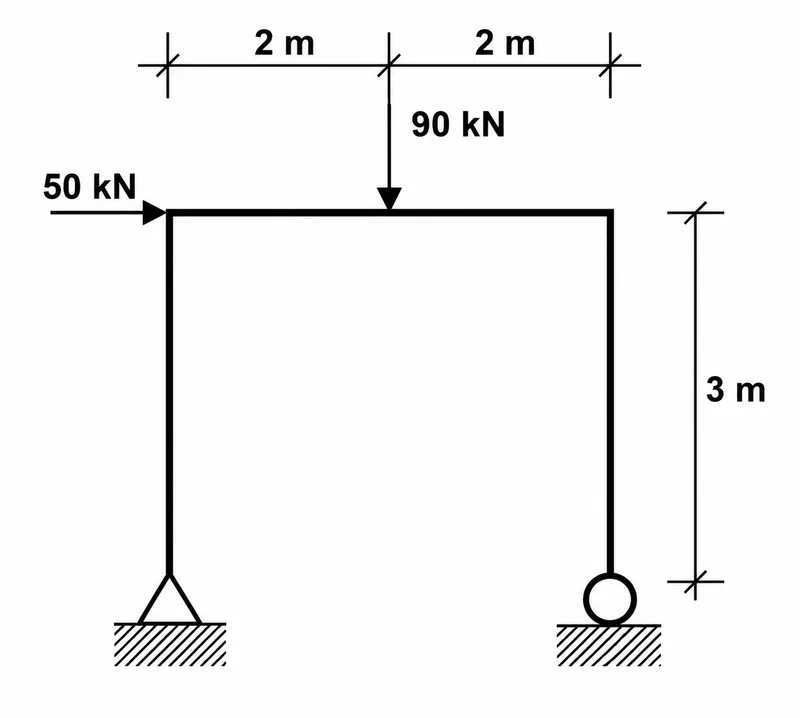
The plane frame has a hinge and a roller support, and is loaded as shown in the figure. Both the columns have same height. What is the absolute value of the maximum bending moment (inkN-m) in the frame?
Correct Answer :
165
Solution :
The correct option is 165.
Here is the detailed, step-by-step structural analysis and calculation to find the maximum bending moment in the frame:
1. Identify the Frame Geometry and Loading:
Let the base of the left column be support (hinged/pin support) and the base of the right column be support (roller support).
Let the top-left joint be and the top-right joint be .
• Height of both columns ( and ):
• Length of the beam ():
• Horizontal load acting at joint towards the right:
• Vertical point load acting at the midspan of beam : (at a distance of from both and )
2. Determine Support Reactions:
Let the vertical and horizontal reactions at the hinged support be (upwards) and (towards the left).
Let the vertical reaction at the roller support be (upwards). Since is a roller on a horizontal surface, there is no horizontal reaction at ().
Applying the equations of static equilibrium:
• Horizontal Equilibrium:
(acting to the left)
• Moment Equilibrium about Point :
Taking counter-clockwise moments about as positive:
• Vertical Equilibrium:
3. Calculate Bending Moments in the Members:
• Column :
At any height from base (where ):
At the base ():
At the joint ():
• Column :
Since support is a roller, the horizontal reaction is zero (). Therefore, there is no bending moment anywhere in the column :
• Beam :
We can analyze the bending moment along the beam from both ends towards the center:
1. Starting from the right joint towards the midspan (let be the distance from , where ):
Under the vertical point load (at ):
2. Starting from the left joint towards the midspan (let be the distance from , where ):
Under the vertical point load (at ):
4. Determine the Maximum Bending Moment:
Comparing the bending moments across the entire frame:
• Maximum moment in column is at joint .
• Bending moment in column is .
• Maximum moment in beam is at the midspan.
Therefore, the absolute value of the maximum bending moment in the frame is 165 kN-m.
Access expert-curated educational resources and study materials—completely free.
Create, conduct, and manage professional online assessments with Mindyard. Perfect for teachers and institutes.
Copyright © 2026 Mindyard. All Rights Reserved.