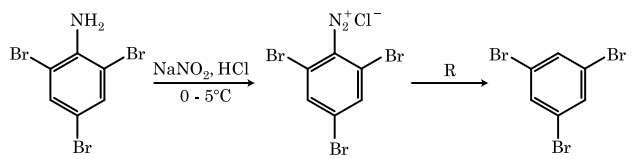
The reagent ‘R’ in the given sequence of chemical reaction is :
Correct Answer :
CH3CH2OH
Solution :
The correct answer is: CH3CH2OH (Ethanol)
Let us analyze the reaction sequence shown in the image step by step.
Step 1: Identify the Starting Material
The starting compound is 2,4,6-tribromoanline — a benzene ring bearing an −NH2 (amine) group and three bromine (Br) substituents at positions 2, 4, and 6.
Step 2: First Reaction — Diazotization
The amine is treated with NaNO2 / HCl at 0–5°C. This is a classic diazotization reaction. The primary aromatic amine (−NH2) reacts with nitrous acid (HNO2, generated in situ from NaNO2 and HCl) at low temperature to form a diazonium salt (−N2+ Cl−).
So the intermediate product is 2,4,6-tribromobenzenediazonium chloride, as clearly shown in the image with the N2+ Cl− group attached to the ring.
Step 3: Second Reaction — Treatment with Reagent 'R'
The diazonium salt is then treated with the unknown reagent R, and the final product shown in the image is 1,3,5-tribromobenzene ��� a benzene ring with only three bromine atoms and no nitrogen-containing group. The −N2+ Cl− group has been replaced by a hydrogen atom (−H).
Step 4: Identify the Reaction Type
The replacement of the diazonium group (−N2+) by a hydrogen atom (−H) is known as deamination or reductive de-diazotization. In this reaction, nitrogen gas (N2) is evolved, and a C−H bond is formed where the C−N2+ bond existed.
Step 5: Which Reagent Achieves This?
The standard reagent used to replace a diazonium group with hydrogen is ethanol (CH3CH2OH). When a diazonium salt is warmed with ethanol, the following occurs:
Ar−N2+ Cl− + CH3CH2OH → Ar−H + N2↑ + CH3CHO + HCl
Ethanol acts as a reducing agent (specifically, a hydride source). It donates a hydrogen atom to the aryl ring, replacing the diazonium group. In the process, ethanol itself gets oxidized to acetaldehyde (CH3CHO), and nitrogen gas is released.
Why not the other options?
• H2O — Water with a diazonium salt would give a phenol (Ar−OH), not Ar−H.
• HI — While HI can also replace −N2+ with −H via a radical pathway, the classical and most widely recognized reagent for this transformation in standard organic chemistry is ethanol.
• CuCN/KCN — This is a Sandmeyer reaction reagent that would replace −N2+ with −CN (a nitrile group), not −H.
Therefore, the reagent R is CH3CH2OH (Ethanol).
Access expert-curated educational resources and study materials—completely free.
Create, conduct, and manage professional online assessments with Mindyard. Perfect for teachers and institutes.
Copyright © 2026 Mindyard. All Rights Reserved.