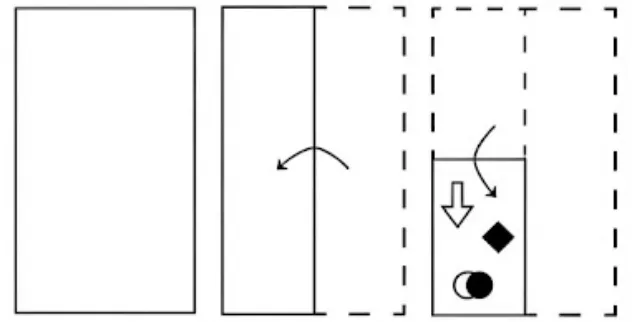
The sequence of folding a paper and the manner in which the folded paper is cut is shown in the following figures. How would this paper look when unfolded?
Options
Correct Answer :
Solution :
Correct Answer:
Step-by-step Explanation:
To determine how the paper looks when unfolded, we trace the folding process in reverse (from the final folded state back to the original fully unfolded paper) by applying symmetry and reflections.
1. Understanding the folding sequence:
• The initial rectangular sheet of paper is first folded in half from right to left along a vertical axis.
• Next, the folded paper is folded in half from top to bottom along a horizontal axis, resulting in the bottom-left quadrant.
• In this final folded bottom-left quadrant, three cuts/designs are made:
- An open block arrow pointing downwards (⇩) on the left side.
- A solid black diamond (◆) near the top-right of this quadrant.
- An overlapping circle design at the bottom edge (consisting of a hollow circle on the left and a solid black circle on the right).
2. Unfolding Step 1 (Vertically upwards):
• We unfold the paper from bottom to top along the horizontal crease line, which creates a vertical reflection of the bottom-left quadrant onto the top-left quadrant.
• The open block arrow pointing down (⇩) is reflected vertically to point upwards (⇧) in the top-left quadrant.
• The solid black diamond (◆) is reflected vertically to the upper half, maintaining its shape.
• The overlapping circle design at the bottom edge (hollow circle on the left, solid circle on the right) is reflected to the top edge, maintaining its left-to-right order (hollow circle on the left, solid circle on the right) because vertical reflection does not invert the horizontal left-right arrangement.
3. Unfolding Step 2 (Horizontally from left to right):
• We now unfold the entire left half of the sheet to the right half along the vertical crease line, which creates a horizontal reflection.
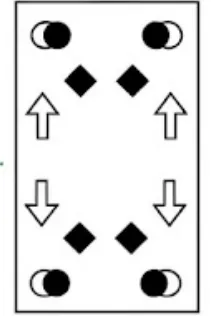
• The open block arrows on the left (pointing down ⇩ at the bottom and up ⇧ at the top) reflect to the right side, maintaining their vertical orientations (pointing down ⇩ at the bottom-right and up ⇧ at the top-right).
• The solid black diamonds reflect to the right side to form a symmetric set of four diamonds pointing towards the center.
• The overlapping circles at the left corners (hollow on the left, solid on the right) reflect horizontally to the right corners. Due to the horizontal reflection, the order swaps: in the right-hand corners, the solid circle will be on the left and the hollow circle will be on the right.
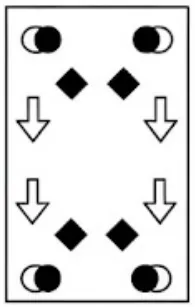
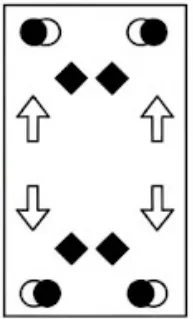
This matches the unfolded pattern shown in the correct option image:
Access expert-curated educational resources and study materials—completely free.
Create, conduct, and manage professional online assessments with Mindyard. Perfect for teachers and institutes.
Copyright © 2026 Mindyard. All Rights Reserved.