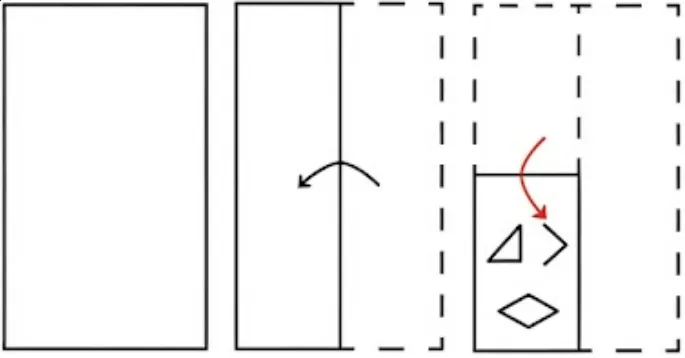
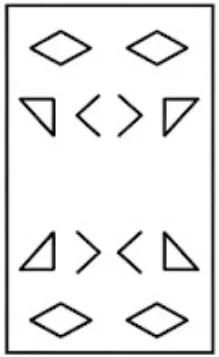
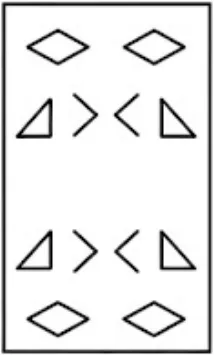
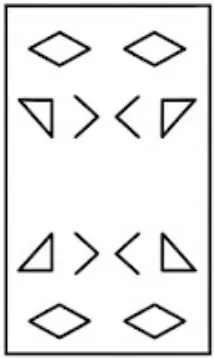
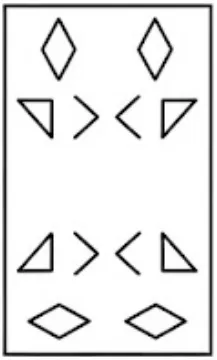
The sequence of folding a paper and the manner in which the folded paper is cut is shown in the following figures. How would this paper look when unfolded?
Options
Correct Answer :
Solution :
The correct option is:
Step-by-Step Explanation:
1. Analyze the Folding Sequence:
- First Fold: A rectangular sheet of paper is folded in half from right to left (as indicated by the horizontal arrow pointing left). This creates a vertical crease along the center-left.
- Second Fold: The folded paper is then folded in half from bottom to top (as indicated by the vertical arrow pointing up). This creates a horizontal crease along the upper edge of the folded square.
2. Analyze the Cuts in the Folded Sheet:
In the final folded square (representing the top-left quarter of the unfolded sheet), the following cuts are made:
- A triangular cut at the top-left corner.
- A circular cut near the top-right corner.
- A diamond-shaped cut (quadrilateral) near the bottom-right corner.
- An irregular hook/corner cut on the bottom-left edge.
3. Unfolding Step-by-Step:
- First Unfolding (Top to Bottom):
When unfolding the paper downwards to restore the bottom half, we reflect all cuts vertically across the horizontal crease line:
- The triangular cut at the top-left corner reflects downwards, forming a symmetric diamond or hourglass-like cutout along the left edge.
- The circle near the top-right reflects downwards to form a pair of vertically aligned circles.
- The diamond cut reflects vertically across the fold to create another diamond directly below it.
- The bottom edge shapes reflect accordingly.
- Second Unfolding (Left to Right):
When unfolding the paper from left to right to restore the original shape, we reflect all shapes horizontally across the central vertical crease:
- The cutouts along the vertical crease merge and replicate symmetrically on the right half.
- The vertical pair of circles on the right side reflects to the left side, resulting in two circles on the left side and two circles on the right side.
- The diamond shapes reflect horizontally to form a symmetrical configuration.
Comparing this symmetrical pattern with the given choices, it perfectly matches the third option:
Access expert-curated educational resources and study materials—completely free.
Create, conduct, and manage professional online assessments with Mindyard. Perfect for teachers and institutes.
Copyright © 2026 Mindyard. All Rights Reserved.