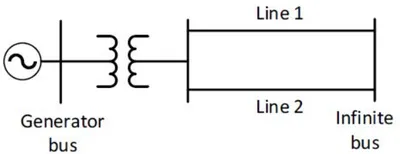
The single line diagram of a lossless system is shown in the figure. The system is operating in steady-state at a stable equilibrium point with the power output of the generator being Pmaxsinδ, where δ is the load angle and the mechanical power input is 0.5Pmax. A fault occurs on line 2 such that the power output of the generator is less than 0.5Pmax during the fault. After the fault is cleared by opening line 2, the power output of the generator is . If the critical fault clearing angle is radians, the accelerating area on the power angle curve is __________ times Pmax (rounded off to decimal places).
Correct Answer :
Solution :
The correct answer is 0.10.
Step-by-step derivation:
1. Identify the System Parameters:
From the single line diagram and the problem statement, we have:
- Pre-fault electrical power output:
- Mechanical power input:
- Post-fault electrical power output (after line 2 is opened to clear the fault):
- Critical clearing angle:
2. Determine the Initial Load Angle ():
In steady-state pre-fault condition, the mechanical input power equals the electrical power output:
3. Determine the Maximum Rotor Angle ():
The maximum limit of the rotor angle for transient stability occurs where the mechanical power line intersects the post-fault power curve on the right-hand side:
Since is in the second quadrant:
4. Find the Accelerating Area () Using the Equal Area Criterion:
According to the Equal Area Criterion, at the critical fault clearing angle, the accelerating area () is equal to the decelerating area ():
The decelerating area () lies between the critical clearing angle and the maximum angle under the post-fault curve:
Substitute the values into the integration:
Evaluate at the upper limit ():
Evaluate at the lower limit ():
Subtract the lower limit evaluation from the upper limit evaluation:
Using :
Therefore, the accelerating area times (rounded off to two decimal places).
Access expert-curated educational resources and study materials—completely free.
Create, conduct, and manage professional online assessments with Mindyard. Perfect for teachers and institutes.
Copyright © 2026 Mindyard. All Rights Reserved.