The torque provided by an engine is given by T(θ) = 12000 + 2500 sin (2θ) N.m, where θ is the angle turned by the crank from the inner dead centre. The mean speed of the engine is 200 rpm and it drives a machine that provides constant resisting torque. If variation of the speed from the mean speed is not to exceed ±0.5%, the minimum mass moment of inertia of the flywheel should be ________ kg.m2 (round off to the nearest integer).
Correct Answer :
Correct answer is : 569.98
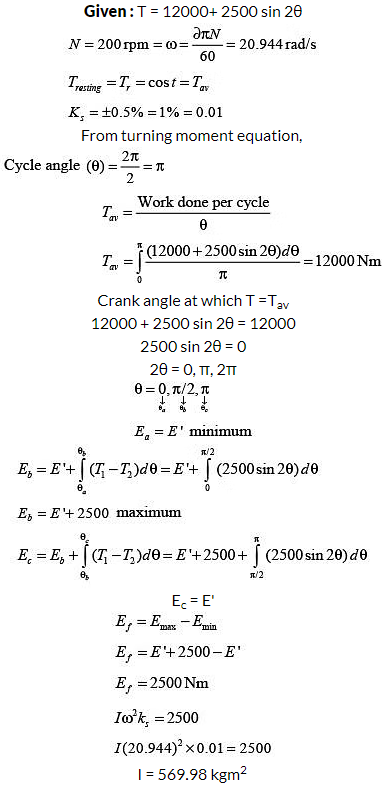
Solution :
The correct answer is 569.98.
Based on the provided image, we can analyze the problem step-by-step to find the minimum mass moment of inertia of the flywheel. Let us extract the details given in the image:
1. Engine torque expression:
2. Mean speed of the engine:
3. The speed variation from the mean speed is limited to ±0.5%.
Step 1: Calculate the mean angular speed ()
Using the relation between rotational speed in rpm and angular velocity in rad/s:
Substituting rpm:
Step 2: Find the coefficient of fluctuation of speed ()
The speed variation is given as ±0.5%. The total fluctuation of speed from minimum to maximum is:
Step 3: Calculate the mean resisting torque ()
Since the torque function is periodic with a period of π, the cycle angle is π. The mean resisting torque matches the average torque over one cycle:
Integrating the term, we get:
Step 4: Find the crank angles where the engine torque equals the resisting torque
Set the engine torque equal to the average torque:
This simplifies to:
Thus, the transition angles over a single cycle are:
Step 5: Determine the maximum fluctuation of energy ()
Let the energy at be .
The energy at is:
Evaluating this integral yields:
This is the maximum energy level. The minimum energy level is (occurring at and ).
Thus, the maximum fluctuation of energy is:
Step 6: Compute the moment of inertia ()
The relation between maximum fluctuation of energy, moment of inertia, mean angular velocity, and coefficient of fluctuation of speed is:
Substituting the calculated values into the formula:
Solving for :
Access expert-curated educational resources and study materials—completely free.
Create, conduct, and manage professional online assessments with Mindyard. Perfect for teachers and institutes.
Copyright © 2026 Mindyard. All Rights Reserved.