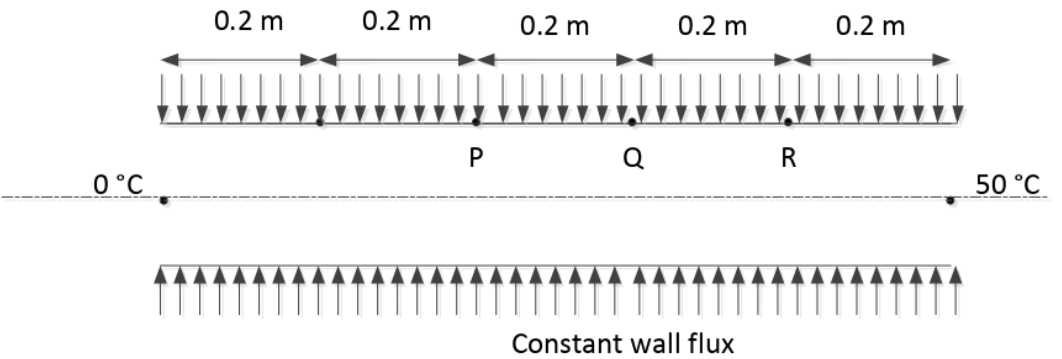
The wall of a constant diameter pipe of length 1 m is heated uniformly with flux q′′ by wrapping a heater coil around it. The flow at the inlet to the pipe is hydrodynamically fully developed. The fluid is incompressible and the flow is assumed to be laminar and steady all through the pipe. The bulk temperature of the fluid is equal to 0°C at the inlet and 50°C at the exit. The wall temperatures are measured at three locations, P, Q and R, as shown in the figure. The flow thermally develops after some distance from the inlet. The following measurements are made:
| Point | P | Q | R |
| Wall Temp(°C) | 50 | 80 | 90 |
Among the locations P, Q and R, the flow is thermally developed at
Correct Answer :
Q and R only
Solution :
The correct option is Q and R only.
Step-by-Step Explanation:
For a fluid flowing through a circular pipe of constant diameter under a constant wall heat flux boundary condition (), the rate of heat transfer is uniform along the length of the pipe. In a steady, laminar, and incompressible flow, the bulk mean temperature of the fluid () increases linearly with distance from the inlet.
The linear profile of the bulk mean temperature is given by:
where:
- at the inlet ()
- at the exit ()
- is the total length of the pipe
Substituting the given values into the bulk temperature equation:
From the schematic diagram in the image, we can determine the coordinates of locations P, Q, and R along the pipe length divided into five equal intervals of each:
- Point P is located at
- Point Q is located at
- Point R is located at
Now, let us calculate the bulk fluid temperatures at these three points:
- At P:
- At Q:
- At R:
By definition, in the thermally fully developed region of a pipe with constant wall heat flux, the local heat transfer coefficient is constant. Since:
it follows that the temperature difference between the inner wall surface and the bulk fluid must be constant:
Let's evaluate the difference at each location:
- At point P:
- At point Q:
- At point R:
Since the temperature difference is equal at points Q and R (both being ), but different at point P (), we conclude that the thermal boundary layer is fully developed at and after point Q. Thus, among the locations P, Q, and R, the flow is thermally developed at Q and R only.
Access expert-curated educational resources and study materials—completely free.
Create, conduct, and manage professional online assessments with Mindyard. Perfect for teachers and institutes.
Copyright © 2026 Mindyard. All Rights Reserved.