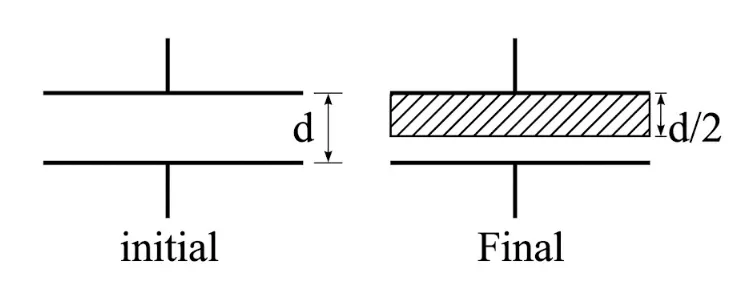
There is a parallel plate capacitor of capacitance C. If half of the spaceis filled withdielectric of dielectric constant k = 5 as in the figure, find the percentage increase in capacitance.
Correct Answer :
Solution :
The correct answer is 66.67%.
Step 1: Understand the Initial State
Based on the provided diagram, the label "initial" shows a parallel plate capacitor where the plates are separated by a distance of in air/vacuum. If we let the area of the plates be , the initial capacitance is given by the formula:
Step 2: Analyze the Final State
The label "Final" in the diagram shows that half of the space is filled with a dielectric material of thickness and dielectric constant . This arrangement divides the capacitor into two separate regions connected in series:
1. A dielectric-filled region of thickness with capacitance .
2. An air-filled region of thickness with capacitance .
Step 3: Calculate the Individual Capacitances
For the dielectric-filled section with :
Substituting :
For the remaining air-filled section:
Step 4: Find the Equivalent Capacitance
Since the two regions are in series, the equivalent final capacitance is calculated as:
Taking the reciprocal to find :
Step 5: Calculate the Percentage Increase in Capacitance
The percentage increase is determined by comparing the change in capacitance to the initial value:
Access expert-curated educational resources and study materials—completely free.
Create, conduct, and manage professional online assessments with Mindyard. Perfect for teachers and institutes.
Copyright © 2026 Mindyard. All Rights Reserved.