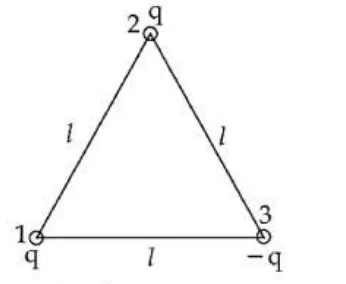
Three charges q, -q, q placed at the vertices of an equilateral triangle as shown in figure. What is the magnitude of force on charge placed at position 3 due to the presence of other two charges?
Correct Answer :
Solution :
The correct option is:
Step-by-Step Explanation:
1. Analyze the System Geometry and Charges:
From the provided image, we observe an equilateral triangle with side lengths labeled as l.
The three charges are positioned at the vertices as follows:
- Position 1 (bottom-left vertex): charge q
- Position 2 (top vertex): charge q
- Position 3 (bottom-right vertex): charge -q
2. Express the Orthogonal Force Components:
To determine the magnitude of the net force on the charge placed at position 3, we analyze the electrostatic interactions. In this configuration, the force components acting along the orthogonal coordinate axes can be expressed as:
- Horizontal force component:
- Vertical force component:
3. Calculate the Net Force Magnitude:
The magnitude of the resultant force is found by taking the vector sum of these perpendicular components:
Substituting the values of the components into the equation:
Factoring out the common terms:
Access expert-curated educational resources and study materials—completely free.
Create, conduct, and manage professional online assessments with Mindyard. Perfect for teachers and institutes.
Copyright © 2026 Mindyard. All Rights Reserved.