Three different positions of the same dice are shown. Find the number on the face opposite the face showing ‘4’.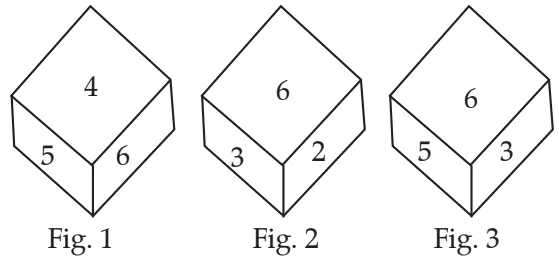
Correct Answer :
3
Solution :
The correct answer is 3.
The image shows three different orientations of the same dice, labelled Fig. 1, Fig. 2, and Fig. 3. Each figure reveals three visible faces of the dice at a time. Let us read off the numbers carefully:
Fig. 1: Top face = 4, Left face = 5, Right face = 6
Fig. 2: Top face = 6, Left face = 3, Right face = 2
Fig. 3: Top face = 6, Left face = 5, Right face = 3
Step 1 — Identify what is opposite to what using Fig. 1 and Fig. 2.
From Fig. 1, the three visible faces are 4 (top), 5 (left), and 6 (right). This tells us that 4, 5, and 6 are all adjacent to each other — none of these three can be opposite to any other in this group.
On a standard die, opposite faces always add up in pairs. The six faces are split into three opposite pairs. Since 4, 5, and 6 are all mutually adjacent (all three visible simultaneously in Fig. 1), the opposite of each must come from the remaining numbers: 1, 2, and 3.
Step 2 — Use Fig. 2 to narrow it down.
From Fig. 2, the visible faces are 6 (top), 3 (left), and 2 (right). This means 6, 3, and 2 are all adjacent to each other.
We already know from Step 1 that 6 is adjacent to both 4 and 5. Now from Fig. 2, 6 is also adjacent to 3 and 2. Therefore, 6 is adjacent to 4, 5, 3, and 2 — which means the only number left, 1, must be opposite to 6.
So: 6 is opposite to 1.
Step 3 — Use Fig. 3 to find the pair involving 4.
From Fig. 3, the visible faces are 6 (top), 5 (left), and 3 (right). This confirms that 6, 5, and 3 are all mutually adjacent.
Now look at the remaining numbers: we have established that 6 ↔ 1. The three remaining opposite pairs must be formed from {4, 5, 2, 3}.
From Fig. 2, we saw that 3 and 2 are both adjacent to 6, and from Fig. 3 we see 3 and 5 are also adjacent. Since 3 is adjacent to 6, 2, and 5, the only number it has not been seen adjacent to is 4. Therefore, 3 must be opposite to 4.
Step 4 — Confirm the remaining pair.
That leaves only 2 and 5 as the final pair: 2 is opposite to 5. This is consistent with all three figures — in Fig. 1, 5 and 2 are never shown as the same face together, confirming they can be opposite.
Summary of opposite pairs:
• 6 ��� 1
• 4 ↔ 3
• 5 ↔ 2
Therefore, the number on the face opposite to the face showing 4 is 3.
Access expert-curated educational resources and study materials—completely free.
Create, conduct, and manage professional online assessments with Mindyard. Perfect for teachers and institutes.
Copyright © 2026 Mindyard. All Rights Reserved.