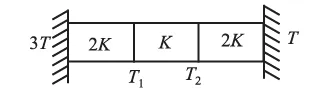
Three identical heat conducting rods are connected in series as shown in the figure. The rods on the sides have thermal conductivity 2K while that in the middle has thermal conductivity K. The left end of the combination is maintained at temperature 3T and the right end at T. The rods are thermally insulated from outside. In steady state, temperature at the left junction is T1 and that at the right junction is T2. The ratio T1/T2 is:
Correct Answer :
5/3
Solution :
Correct Option: 5/3
Step-by-step Explanation:
In the given diagram, we can observe three identical conducting rods connected in series between two walls:
1. The leftmost rod has a thermal conductivity of 2K, and its left end is in contact with a reservoir at temperature 3T.
2. The middle rod has a thermal conductivity of K.
3. The rightmost rod has a thermal conductivity of 2K, and its right end is in contact with a reservoir at temperature T.
4. The junction between the first and second rod is at temperature T1, and the junction between the second and third rod is at temperature T2.
Since the rods are identical, they all have the same length (L) and cross-sectional area (A).
Using the formula for thermal resistance:
where k is the thermal conductivity of the material.
Let the thermal resistance of the middle rod (with conductivity K) be R:
Then, the thermal resistances of the left and right rods (each with conductivity 2K) are:
Since the three rods are connected in series, the rate of heat flow (heat current, H) must be the same through each rod under steady-state conditions:
Substituting the values of the resistances in terms of R:
From the equality of the first and third terms:
which simplifies to:
(Equation 1)
Next, equating the second and third terms:
(Equation 2)
Subtracting Equation 2 from Equation 1:
Now, substituting the value of T2 back into Equation 1:
Finally, we find the ratio of T1 to T2:
Access expert-curated educational resources and study materials—completely free.
Create, conduct, and manage professional online assessments with Mindyard. Perfect for teachers and institutes.
Copyright © 2026 Mindyard. All Rights Reserved.