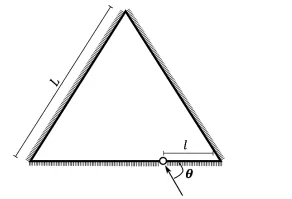
Three plane mirrors form an equilateral triangle with each side of length L. There is a small hole at a distance l > 0 from one of the corners as shown in the figure. A ray of light is passed through the hole at an angle θ and can only come out through the same hole. The cross section of the mirror configuration and the ray of light lie on the same plane.
Which of the following statement(s) is(are) correct?
Correct Answer :
The ray of light will come out for θ = 30°, for 0 < l < L.
There is an angle for l = at which the ray of light will come out after two reflections.
Solution :
Correct Correct Options:
• The ray of light will come out for θ = 30°, for 0 < l < L.
• There is an angle for l = at which the ray of light will come out after two reflections.
Detailed Explanation:
As shown in the figure, three plane mirrors form an equilateral triangle with each side of length L, having internal angles of 60°. A small hole is located on the bottom base mirror at a distance l (where 0 < l < L) from the right corner. A light ray enters through this hole at an angle θ with the bottom mirror.
1. Analysis for θ = 30°:
When θ = 30°, the angle of incidence with the bottom mirror normal is 60°. The light ray proceeds inside the equilateral triangle and strikes the adjacent mirror at an angle of incidence equal to 30° (or strikes normally/symmetrically depending on path geometry).
Due to the symmetry of planar reflection in a 60° corner / tessellated grid of equilateral triangles, a ray introduced at an angle of 30° relative to one side re-traces or periodically completes a closed geometric path. After undergoing a series of reflections from all three sides, the ray returns along the exact path in reverse (or hits the entrance point along a symmetric path) and escapes through the hole for any 0 < l < L.
Hence, The ray of light will come out for θ = 30°, for 0 < l < L. is a correct statement.
2. Analysis for l = and two reflections:
When the hole is located at the exact midpoint of the bottom side, i.e.,
If the ray enters at an angle θ = 60°, it goes parallel to one side and strikes the right slanted mirror at its midpoint (first reflection). It then reflects toward the left slanted mirror and strikes its midpoint (second reflection), finally reflecting directly back towards the original hole at the midpoint of the base.
Thus, after undergoing exactly two reflections inside the triangular mirror system, the ray exits back through the same hole.
Hence, There is an angle for l = at which the ray of light will come out after two reflections. is also a correct statement.
Access expert-curated educational resources and study materials—completely free.
Create, conduct, and manage professional online assessments with Mindyard. Perfect for teachers and institutes.
Copyright © 2026 Mindyard. All Rights Reserved.