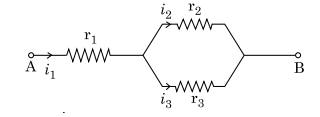
Three resistors having resistances r1, r2 and r3 are connected as shown in the given circuit. The ratio i3/i1 of currents in terms of resistances used in the circuit is :
Correct Answer :
r2/ r2 + r3
r2/(r2+r3)
Solution :
The circuit shown in the image consists of resistor connected in series with a junction that splits into two parallel branches. One branch contains resistor and the other branch contains resistor . The currents in the three resistors are denoted as (through ), (through ) and (through ).
Because and are in parallel, they share the same voltage across them. Let the total current entering the parallel network be . By the current‑division rule, the current flowing through a particular branch of a parallel network is proportional to the conductance (reciprocal of resistance) of the other branch:
where and . Substituting the conductances gives:
Multiplying numerator and denominator by simplifies the expression:
Taking the ratio :
Thus the required ratio of currents expressed in terms of the resistances is:
Access expert-curated educational resources and study materials—completely free.
Create, conduct, and manage professional online assessments with Mindyard. Perfect for teachers and institutes.
Copyright © 2026 Mindyard. All Rights Reserved.