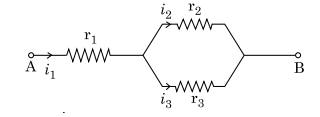
Three resistors having resistances r1, r2 and r3 are connected as shown in the given circuit. The ratio i₃/i₁ of currents in terms of resistances used in the circuit is :
Correct Answer :
r₂/r₂+r₃
Solution :
The correct answer is r2 / (r2 + r3).
Based on the standard configuration shown in the circuit diagram, the main current enters a junction and splits into a parallel combination of two branches containing resistors and , with currents and flowing through them respectively.
When a current splits into parallel branches, the potential difference (voltage) across the parallel combination must be the same for all branches. According to Ohm's law, we can write:
According to Kirchhoff's Current Law, the total current entering the junction is exactly equal to the sum of the currents leaving it in the parallel branches:
From our voltage equality , we can express the current purely in terms of :
Next, we substitute this expression for back into our total current equation:
Now, factor out from the right side of the equation:
Find a common denominator for the terms inside the parenthesis:
Finally, to find the desired ratio of to , we simply rearrange the equation by dividing both sides by and multiplying by the reciprocal of the fraction:
This is the fundamental proof for the current divider rule, confirming that the fraction of the total current flowing through one branch is proportional to the resistance of the opposite parallel branch divided by the total sum of the parallel resistances.
Access expert-curated educational resources and study materials—completely free.
Create, conduct, and manage professional online assessments with Mindyard. Perfect for teachers and institutes.
Copyright © 2026 Mindyard. All Rights Reserved.