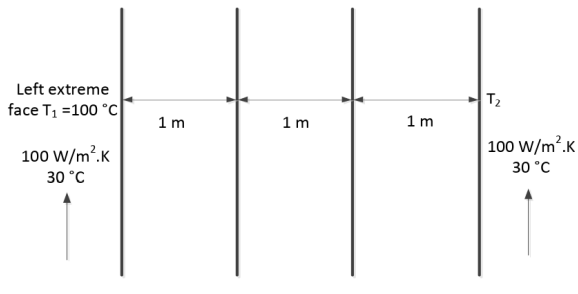
Three slabs are joined together as shown in the figure. There is no thermal contact resistance at the interfaces. The center slab experiences a non-uniform internal heat generation with an average value equal to 10000 Wm–3, while the left and right slabs have no internal heat generation. All slabs have thickness equal to 1 m and thermal conductivity of each slab is equal to 5 Wm–1K–1. The two extreme faces are exposed to fluid with heat transfer coefficient
100Wm–2K–1 and bulk temperature 30°C as shown. The heat transfer in the slabs is assumed to be one dimensional and steady, and all properties are constant. If the left extreme face temperature T1 is measured to be 100°C, the right extreme face temperature T2 is __________°C.
Correct Answer :
Solution :
The correct answer is 60.
Step-by-Step Explanation:
To determine the temperature of the right extreme face, , we can apply the principle of conservation of energy to the entire three-slab system under steady-state conditions.
1. Define the Control Volume and System Parameters:
Based on the provided problem description and image, the system consists of three adjacent slabs, each of thickness 1 m:
- Left slab: Thickness , thermal conductivity , and no internal heat generation.
- Center slab: Thickness , thermal conductivity , with a non-uniform internal heat generation having an average value of .
- Right slab: Thickness , thermal conductivity , and no internal heat generation.
- The left extreme face is at temperature .
- The right extreme face is at temperature .
- Both outer surfaces are exposed to a fluid at bulk temperature with a convective heat transfer coefficient .
2. Calculate the Total Heat Generation Rate:
The heat is generated only in the middle slab. The total rate of heat generated per unit cross-sectional area () is given by:
Substituting the given values:
3. Convective Heat Flux from the Left Face:
The heat flux leaving the left extreme face of the system to the surrounding fluid by convection is:
Substituting the given values:
4. Energy Balance on the Entire System:
Under steady-state conditions, the rate of heat generated within the system must equal the net rate of heat leaving the boundary surfaces of the system. Therefore:
where is the convective heat flux leaving the right extreme face:
Substituting the known values into the energy balance equation:
5. Solve for :
Now, using the expression for :
Divide both sides by 100:
Access expert-curated educational resources and study materials—completely free.
Create, conduct, and manage professional online assessments with Mindyard. Perfect for teachers and institutes.
Copyright © 2026 Mindyard. All Rights Reserved.