
Treatment of D-glucose with aqueous NaOH results in a mixture of monosaccharides, which are
Options
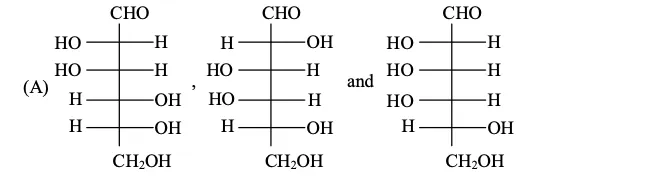
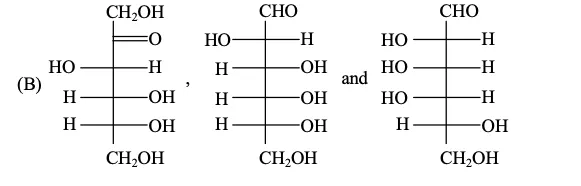
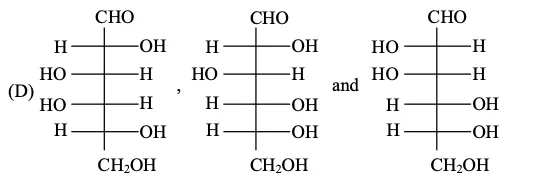
Solution :
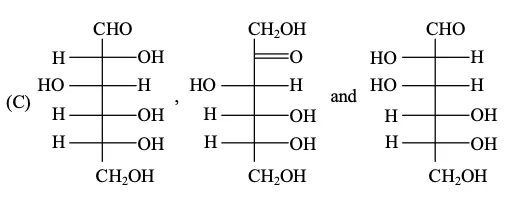
The correct option is shown in the image below:
Lobry de Bruyn-Alberda van Ekenstein Transformation:
When D-glucose is treated with a dilute aqueous base such as NaOH, it undergoes a rearrangement known as the Lobry de Bruyn-Alberda van Ekenstein transformation. This reaction involves an enolization process via an endiol intermediate (1,2-enediol).
During this transformation, D-glucose undergoes epimerization at carbon-2 (C-2) as well as aldose-ketose isomerization to form an equilibrium mixture containing three monosaccharides:
1. D-fructose (a ketohexose):
Structure has a carbonyl at C-2 (C=O), with C-3 having -OH on the left, and C-4, C-5 having -OH on the right (along with terminal -CH2OH groups at C-1 and C-6).
2. D-glucose (the starting aldohexose):
Fischer projection configuration at carbons C-2, C-3, C-4, C-5 is: C-2 (R, -OH on right), C-3 (S, -OH on left), C-4 (R, -OH on right), C-5 (R, -OH on right).
3. D-mannose (the C-2 epimer of D-glucose):
Fischer projection configuration at carbons C-2, C-3, C-4, C-5 is: C-2 (S, -OH on left), C-3 (S, -OH on left), C-4 (R, -OH on right), C-5 (R, -OH on right).
Analyzing the options from the provided images:
- Structure 1 (D-fructose): Shows CH2OH at top, C=O at C-2, C-3 with -OH on left, C-4 with -OH on right, C-5 with -OH on right, and CH2OH at bottom.
- Structure 2 (D-glucose): Shows CHO at top, C-2 with -OH on right, C-3 with -OH on left, C-4 with -OH on right, C-5 with -OH on right, and CH2OH at bottom.
- Structure 3 (D-mannose): Shows CHO at top, C-2 with -OH on left, C-3 with -OH on left, C-4 with -OH on right, C-5 with -OH on right, and CH2OH at bottom.
Thus, the reaction results in a mixture of D-fructose, D-glucose, and D-mannose, which perfectly corresponds to option (C).
Completely free for students. Educators & coaching institutes get 2 months free Pro trial to create tests.
Access unlimited practice questions, detailed step-by-step solutions, and exam study materials — completely free for students.
Create and conduct professional online assessments with AI question generation, tab proctoring, and comprehensive batch management.

A comprehensive JEE Advanced 2022 Paper 1 designed to help aspirants understand the examination pattern, difficulty level, and question trends of JEE Advanced. This paper covers important concepts from Physics, Chemistry, and Mathematics, featuring a balanced mix of conceptual, numerical, and advanced application-based questions. It helps students strengthen conceptual understanding, enhance analytical and problem-solving skills, and improve speed and accuracy. Ideal for practice, revision, self-assessment, previous year trend analysis, concept reinforcement, and time management, this paper is a valuable resource for effective JEE Advanced preparation.

A comprehensive JEE Advanced 2022 Paper 2 designed to help aspirants understand the examination pattern, difficulty level, and question trends of JEE Advanced. This paper covers important concepts from Physics, Chemistry, and Mathematics, featuring a balanced mix of conceptual, numerical, and advanced application-based questions. It helps students strengthen conceptual understanding, enhance analytical and problem-solving skills, and improve speed and accuracy. Ideal for practice, revision, self-assessment, previous year trend analysis, concept reinforcement, and time management, this paper is a valuable resource for effective JEE Advanced preparation.
Copyright © 2026 Combe Labs Private Limited. All Rights Reserved.


