Correct Answer :
Solution :
Correct Answer/Option:
The correct answer is:
Step-by-Step Explanation:
1. Understanding the Electric Field Distribution:
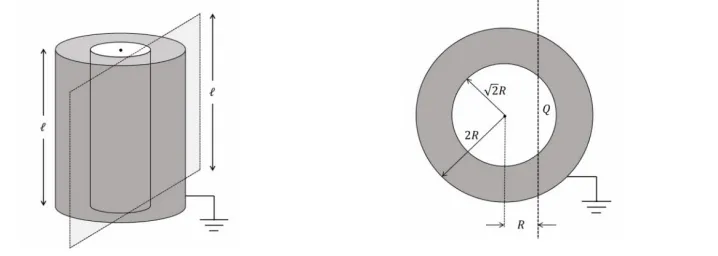
We are given two coaxial conducting cylinders of length ℓ. The inner cylinder has a radius of
and carries a total charge Q. The outer cylinder has a radius of 2R and is grounded.
Since the inner cylinder is a conductor, all its charge Q resides on its outer surface (at
).
Electrostatic theory dictates that:
• The electric field inside the inner conductor (for
)
is zero:
.
• The electric field exists only in the annular region between the cylinders, i.e., for
,
which is filled with a dielectric of constant
.
2. Finding the Electric Field in the Annular Region:
Applying Gauss's Law in the dielectric region for a coaxial cylinder of radius r and length ℓ:
Since
,
the electric field E(r) at a radial distance r is:
3. Determining the Intersection of the Plane with the Electric Field:
We consider an imaginary plane of length ℓ located parallel to the axis at a distance R from the center.
Let us choose a Cartesian coordinate system where the cylinder's axis is along the z-axis. The equation of the plane is then
.
The distance r of any point on the plane from the axis is:
As analyzed, the electric field is non-zero only in the region
.
Thus:
Squaring all terms:
This yields two symmetric intervals along the y-direction where the field passes through the plane:
4. Calculating the Flux:
The normal vector to the plane at
points in the x-direction. The component of the radial electric field perpendicular to this plane is:
Substituting E(r):
The total flux
through the plane is the sum of the fluxes through both symmetric segments:
Using the standard integration formula
:
Since
and
:
5. Substituting the Given Value of Dielectric Constant:
Given
:
Access expert-curated educational resources and study materials—completely free.
Create, conduct, and manage professional online assessments with Mindyard. Perfect for teachers and institutes.
Copyright © 2026 Mindyard. All Rights Reserved.