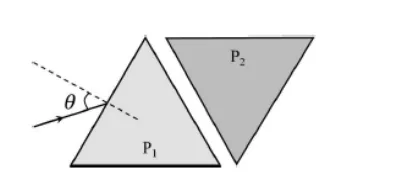
Correct Answer :
Solution :
The correct answer is 12.
1. Understanding the Given Parameters:
We are given two equilateral triangular prisms, and . Since both are equilateral prisms, their refracting angles are:
The refractive indices of the prisms are:
Refractive index of :
Refractive index of :
2. Minimum Deviation in Prism :
For a ray undergoing minimum deviation inside an equilateral prism of refractive index , the angle of refraction inside the prism is:
Using Snell's law at the first surface of prism (where the incident ray comes from vacuum into ):
Substitute and :
Thus, the angle of entry into prism is:
3. Ray Trajectory between Prism and :
The right face of and the left face of are parallel to each other. Therefore, the angle of emergence from the second face of prism must equal the angle of incidence on prism :
4. Refraction inside Prism :
Using Snell's law at the emergent face of :
Substitute and :
Solving for :
Hence, the angle of refraction at the second surface of is:
For prism , the relation between the refracting angle and internal angles of refraction and is:
Substitute and :
5. Finding the Angle of Incidence :
Using Snell's law at the first surface of :
Substitute and :
Taking the inverse sine of both sides:
Comparing this expression with the given form:
We find that:
Access expert-curated educational resources and study materials—completely free.
Create, conduct, and manage professional online assessments with Mindyard. Perfect for teachers and institutes.
Copyright © 2026 Mindyard. All Rights Reserved.