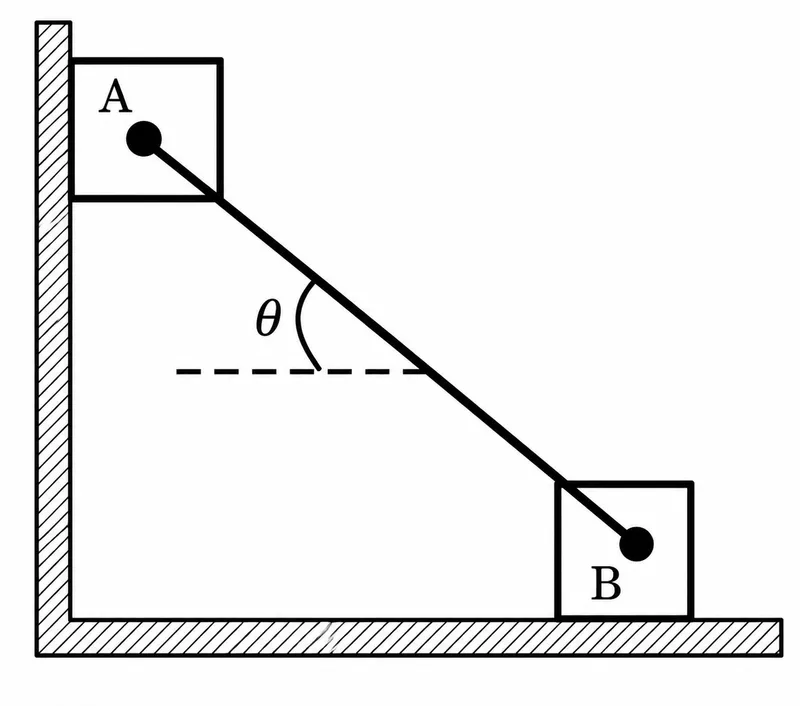
Two identical blocks A and B are connected by a rigid rod. The blocks rest against vertical and horizontal planes, as shown in the figure. The coefficient of static friction at the vertical and horizontal planes is the same. If the sliding im pends when θ = 45◦, the value of the coefficient of static friction is off to two decimal places).
Correct Answer :
0.41
Solution :
The correct option is 0.41.
Analysis of the System:
The given setup consists of two identical blocks, A and B, each of weight (where ). Block A rests against a vertical wall, and Block B rests on a horizontal floor. They are connected by a rigid rod making an angle with the horizontal. The coefficient of static friction at both contact surfaces is .
When sliding is impending (at ), Block A tends to slide downwards, and Block B tends to slide horizontally to the right. Due to this movement, the rigid rod is under compression, exerting a compressive force along its length on both blocks.
1. Equilibrium of Block A (at the vertical wall):
Block A experiences the following forces:
For horizontal equilibrium of Block A:
For vertical equilibrium of Block A:
Substituting and into the equation:
Factoring out :
(Equation 1)
2. Equilibrium of Block B (on the horizontal floor):
Block B experiences the following forces:
For vertical equilibrium of Block B:
For horizontal equilibrium of Block B:
Substituting into the equation:
(Equation 2)
3. Solving for the Coefficient of Friction ():
Substitute the expression for from Equation 1 into Equation 2:
Dividing both sides by :
Divide the entire equation by :
Since sliding impends when the angle , and we know that :
Solving this quadratic equation for the positive root of :
Since :
Rounding off to two decimal places, we get:
Access expert-curated educational resources and study materials—completely free.
Create, conduct, and manage professional online assessments with Mindyard. Perfect for teachers and institutes.
Copyright © 2026 Mindyard. All Rights Reserved.