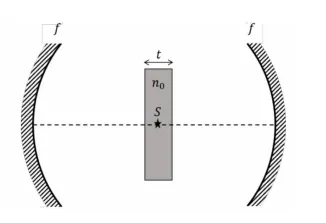
Two identical concave mirrors each of focal length f are facing each other as shown in the schematic diagram. The focal length f is much larger than the size of the mirrors. A glass slab of thickness t and refractive index n0 is kept equidistant from the mirrors and perpendicular to their common principal axis. A monochromatic point light source S is embedded at the center of the slab on the principal axis, as shown in the schematic diagram. For the image to be formed on S itself, which of the following distances between the two mirrors is/are correct:
Correct Answer :
Solution :
The correct options are:
1.
2.
Step-by-Step Explanation:
1. Understanding the Setup:
We are given two identical concave mirrors, each of focal length , facing each other. Let the distance between the two mirrors be . A glass slab of thickness and refractive index is placed equidistant from the mirrors, and a point source is embedded at the center of the slab.
2. Finding the Apparent Distance of the Source from the Mirrors:
Since the source is at the center of the slab, the distance from to either face of the slab is .
When light traveling from emerges from the slab into the surrounding air, it undergoes refraction, resulting in an apparent shift of the position of towards the boundary of the slab.
The apparent shift due to the half-slab is given by:
The physical distance from either mirror to the center of the slab is . Therefore, the apparent distance of the source from either mirror is:
3. Determining Conditions for Image Formation on the Source Itself:
Case I: Light rays retrace their path
For the image to form back on the source after reflection from one of the mirrors, the rays must fall normally on the mirror. This happens if the apparent position of the source lies at the center of curvature of the mirror (at distance ).
Setting the apparent distance equal to :
Substitute the expression for :
Multiply both sides by 2:
Rearranging for the mirror distance :
Case II: Rays become parallel to the principal axis after reflection
Alternatively, if the apparent position of the source lies at the focus of one mirror, the reflected rays will travel parallel to the principal axis. These parallel rays will then strike the second mirror. Since they are parallel to the principal axis, they will converge at the focus of the second mirror, which also matches the apparent position of the source due to symmetry. Thus, the image is formed on the source after two reflections.
Setting the apparent distance equal to :
Substitute the expression for :
Multiply both sides by 2:
Rearranging for the mirror distance :
Access expert-curated educational resources and study materials—completely free.
Create, conduct, and manage professional online assessments with Mindyard. Perfect for teachers and institutes.
Copyright © 2026 Mindyard. All Rights Reserved.