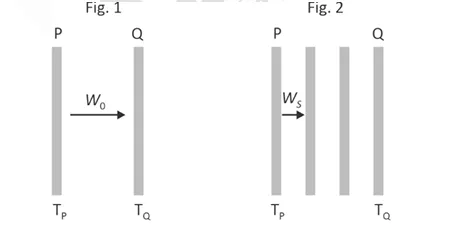
Two identical plates P and Q, radiating as perfect black bodies, are kept in vacuum at constant absolute temperatures TP and TQ, respectively, with TQ < TP, as shown in Fig. 1. The radiated power transferred per unit area from P to Q is W0. Subsequently, two more plates, identical to P and Q, are introduced between P and Q, as shown in Fig. 2. Assume that heat transfer takes place only between adjacent plates. If the power transferred per unit area in the direction from P to Q (Fig. 2) in the steady state is WS, then the ratio W0/Ws is ________
Correct Answer :
Solution :
The correct answer is 3.
Step-by-step Explanation:
1. Initial State (Fig. 1):
In Fig. 1 of the provided image, two identical parallel plates, P and Q, behave as perfect black bodies (emissivity ). They are kept in a vacuum at constant absolute temperatures and respectively. The net radiated power transferred per unit area from plate P to plate Q is labeled as .
According to the Stefan-Boltzmann law, the net heat transfer per unit area between two parallel black body plates is given by:
where is the Stefan-Boltzmann constant.
2. Subsequent State with Intermediate Plates (Fig. 2):
In Fig. 2, two additional identical plates are introduced between P and Q. Let us label the temperatures of these two intermediate plates as and in order from left to right. Now, there are three consecutive gaps between the adjacent plates:
- Gap 1: between Plate P (at ) and Plate 1 (at )
- Gap 2: between Plate 1 (at ) and Plate 2 (at )
- Gap 3: between Plate 2 (at ) and Plate Q (at )
In the steady state, the net heat transfer per unit area must be the same across all adjacent gaps to prevent any continuous change in the temperatures of the intermediate plates. Let this steady-state power transfer per unit area be . The rate of heat transfer through each gap is written as:
3. Calculating the Ratio:
Dividing each equation by and summing them up eliminates the unknown intermediate temperatures and :
Multiplying both sides by gives:
Since , we substitute into the equation:
Rearranging for the required ratio, we get:
Access expert-curated educational resources and study materials—completely free.
Create, conduct, and manage professional online assessments with Mindyard. Perfect for teachers and institutes.
Copyright © 2026 Mindyard. All Rights Reserved.