
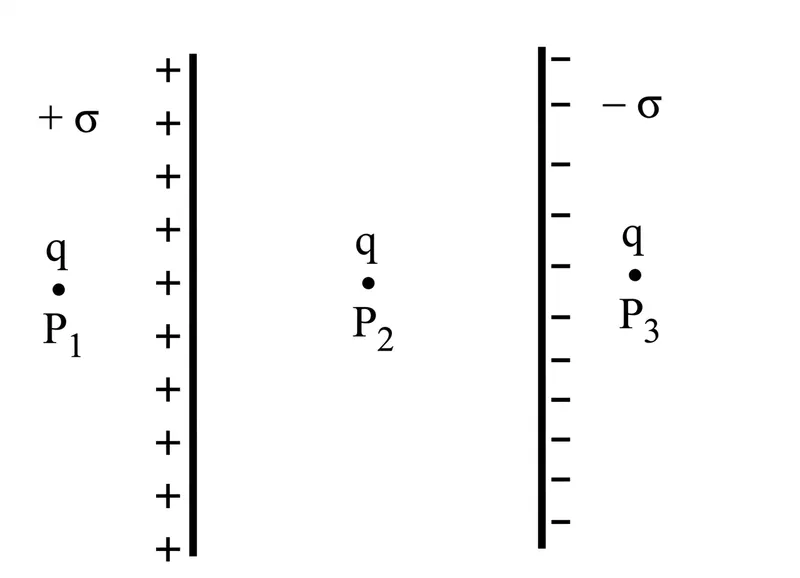
Two large plane parallel sheets shown in the figure have equal but opposite surface charge densities +σ and–σ. A point charge q placed at points P1, P2, and P3 experiences forces F1, F2, and F3 respectively. Then,
Choose the correct answer from the options given below.
Solution :
The correct answer is:
Step-by-Step Explanation:
1. Understanding the Setup from the Image:
The provided image shows two large, vertical, parallel plane sheets:
- The left sheet has a uniform positive surface charge density of .
- The right sheet has a uniform negative surface charge density of .
Three distinct points are marked:
- P1: located in the region to the left of the positive sheet.
- P2: located in the region between the two parallel sheets.
- P3: located in the region to the right of the negative sheet.
At each of these points, a test point charge is placed, experiencing forces , , and respectively.
2. Electric Field due to an Infinite Plane Sheet of Charge:
According to Gauss's Law, the magnitude of the electric field produced by an infinite, non-conducting plane sheet of uniform surface charge density at any nearby point is constant (independent of the distance from the sheet) and is given by:
The direction of this electric field is:
- Directed perpendicularly away from the sheet if the charge is positive ().
- Directed perpendicularly towards the sheet if the charge is negative ().
3. Calculating the Net Electric Field and Force at Each Point:
At Point P1 (Left Region):
- The electric field due to the positive sheet () points to the left (away from it).
- The electric field due to the negative sheet () points to the right (towards it).
Since the magnitudes are equal:
Therefore, the force experienced by the charge at P1 is:
At Point P2 (Middle Region):
- The electric field due to the positive sheet () points to the right (away from it).
- The electric field due to the negative sheet () also points to the right (towards it).
Since both fields point in the same direction, they reinforce each other:
Therefore, the force experienced by the charge at P2 is non-zero:
At Point P3 (Right Region):
- The electric field due to the positive sheet () points to the right (away from it).
- The electric field due to the negative sheet () points to the left (towards it).
Since the magnitudes are equal and opposite:
Therefore, the force experienced by the charge at P3 is:
4. Summary of Results:
- At P1:
- At P2:
- At P3:
This perfectly matches the correct option.
Completely free for students. Educators & coaching institutes get 2 months free Pro trial to create tests.
Access unlimited practice questions, detailed step-by-step solutions, and exam study materials — completely free for students.
Create and conduct professional online assessments with AI question generation, tab proctoring, and comprehensive batch management.

A comprehensive JEE Advanced 2022 Paper 1 designed to help aspirants understand the examination pattern, difficulty level, and question trends of JEE Advanced. This paper covers important concepts from Physics, Chemistry, and Mathematics, featuring a balanced mix of conceptual, numerical, and advanced application-based questions. It helps students strengthen conceptual understanding, enhance analytical and problem-solving skills, and improve speed and accuracy. Ideal for practice, revision, self-assessment, previous year trend analysis, concept reinforcement, and time management, this paper is a valuable resource for effective JEE Advanced preparation.

A comprehensive JEE Advanced 2022 Paper 2 designed to help aspirants understand the examination pattern, difficulty level, and question trends of JEE Advanced. This paper covers important concepts from Physics, Chemistry, and Mathematics, featuring a balanced mix of conceptual, numerical, and advanced application-based questions. It helps students strengthen conceptual understanding, enhance analytical and problem-solving skills, and improve speed and accuracy. Ideal for practice, revision, self-assessment, previous year trend analysis, concept reinforcement, and time management, this paper is a valuable resource for effective JEE Advanced preparation.
Copyright © 2026 Combe Labs Private Limited. All Rights Reserved.


