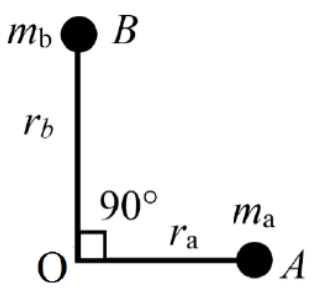
Two masses A and B having mass ma and mb, respectively, lying in the plane of the figure shown, are rigidly attached to a shaft which revolves about an axis through O perpendicular to the plane of the figure. The radii of rotation of the masses ma and mb are ra and rb, respectively. The angle between lines OA and OB is 90°. If ma = 10 kg, mb = 20 kg, ra =200 mm and rb, = 400 mm, then the balance mass to be placed at a radius of 200 mm is---------- kg (round off to two decimal places).
Correct Answer :
Solution :
The correct answer is 41.23.
1. Understand the System Configuration:
We are given two masses, and , attached to a rotating shaft. The axis of rotation passes through and is perpendicular to the plane containing the lines of action and shown in the image. The angle between and is .
Let us choose a coordinate system where the line lies along the positive x-axis and the line lies along the positive y-axis.
2. Given Data:
Mass of A,
Mass of B,
Radius of rotation of A,
Radius of rotation of B,
Radius of rotation of the balance mass,
3. Calculate Centrifugal Force Components:
For a shaft rotating with angular velocity , the centrifugal force on any mass at a radius is proportional to the product .
Let us compute the mass-radius products for both masses A and B:
For mass A:
For mass B:
4. Determine the Resultant Mass-Radius Product:
Since the two lines of action are perpendicular (), the resultant mass-radius product is found using the Pythagorean theorem:
Substituting the calculated values:
5. Find the Balance Mass:
To balance the system dynamically, the mass-radius product of the balancing mass placed at radius must be equal to the resultant mass-radius product:
Thus, the required balance mass to be placed at a radius of 200 mm is approximately 41.23 kg.
Access expert-curated educational resources and study materials—completely free.
Create, conduct, and manage professional online assessments with Mindyard. Perfect for teachers and institutes.
Copyright © 2026 Mindyard. All Rights Reserved.