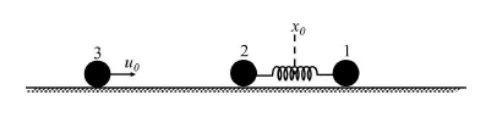
Two particles, 1 and 2, each of mass m , are connected by a massless spring, and are on a horizontal frictionless plane, as shown in the figure. Initially, the two particles, with their center of mass at x0 , are oscillating with amplitude a and angular frequency ω . Thus, their positions at time t are given by x1(t) = (x0 + d) + a sin ωt and x2(t) = (x0 − d) − a sin ωt , respectively, where d > 2a . Particle 3 of mass m moves towards this system with speed u0 = aω/2 , and undergoes instantaneous elastic collision with particle 2, at time t0 . Finally, particles 1 and 2 acquire a center of mass speed vcm and oscillate with amplitude b and the same angular frequency ω .
If the collision occurs at time t0 = π/(2ω) , then the value of 4b 2 /a 2 will be
Correct Answer :
Solution :
The correct answer is 4.25 (or 17/4).
Analysis of the Given Data:
From the problem description and the attached diagram, we have three identical particles of mass m on a horizontal frictionless surface:
• Particle 1 and Particle 2 are connected by a spring.
• Particle 3 moves to the right with velocity towards particle 2.
• Before collision, the equations of motion for particles 1 and 2 are:
Step 1: Velocities of particles just before collision
Differentiating the positions with respect to time t, we get the velocities:
At the time of collision :
Therefore,
Hence, just before the collision at :
•
•
• The compression/elongation of the spring is at maximum amplitude, meaning the stored potential energy in the spring is or in terms of reduced mass , the oscillation energy is .
Step 2: Analysis of the Elastic Collision
Particle 3 of mass m traveling at velocity collides head-on elastically with particle 2 (which is at rest at ).
Since particles 2 and 3 have equal masses, an instantaneous elastic collision causes them to exchange their velocities.
• Velocity of particle 3 after collision:
• Velocity of particle 2 immediately after collision:
• Velocity of particle 1 remains unchanged:
Step 3: Post-collision motion of system (Particles 1 and 2)
Immediately after the collision, the new velocities of particles 1 and 2 are:
, and
The velocity of the center of mass of particles 1 and 2 after collision is:
Step 4: Finding the new amplitude of oscillation b
The total energy of the 2-particle system immediately after collision consists of center of mass kinetic energy and internal oscillation energy:
Alternatively, calculating kinetic energy + spring potential energy directly:
• Total Kinetic Energy after collision:
• Potential Energy stored in the spring at :
Since the relative position between the two particles at is unchanged by the instantaneous collision, the potential energy remains:
• Total internal oscillation energy after collision:
Where
Substituting into the expression for new oscillation energy:
The new amplitude of oscillation of each particle is b (so relative oscillation amplitude is 2b):
Equating the two expressions for :
Multiplying by 4 on both sides gives:
Thus, the required value of is 4.25.
Access expert-curated educational resources and study materials—completely free.
Create, conduct, and manage professional online assessments with Mindyard. Perfect for teachers and institutes.
Copyright © 2026 Mindyard. All Rights Reserved.