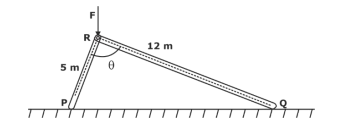
Two rigid massless rods PR and RQ are joined at frictionless pin-joint R and are resting on ground at P and Q, respectively, as shown in the figure. A vertical force F acts on the pin R as shown. When the included angle 𝜃 < 90°, the rods remain in static equilibrium due to Coulomb friction between the rods and ground at locations P and Q. At 𝜃 = 90°, impending slip occurs simultaneously at points P and Q. Then the ratio of the coefficient of friction at Q to that at P (μQ/μP) is _________ (round off to two decimal places).
Correct Answer :
Correct answer is : 5.76
Solution :
The correct answer is 5.76.
Step-by-Step Explanation:
1. Analyze the Geometry of the System:
From the provided image, we have a system of two rigid massless rods, and , connected by a frictionless pin-joint at . The lengths of the rods are:
Length of rod
Length of rod
At the state of impending slip, the included angle is:
Since the angle at vertex is , the triangle forms a right-angled triangle with the ground acting as the hypotenuse .
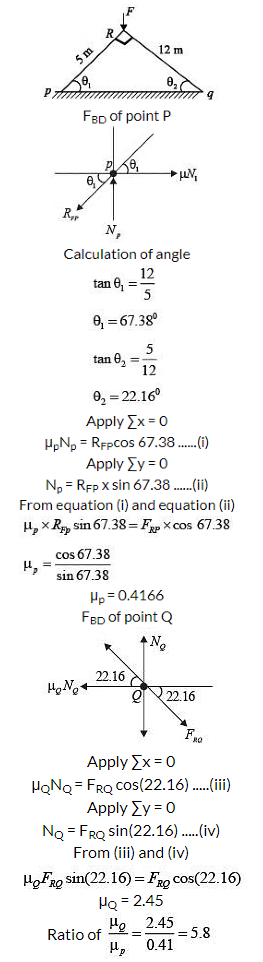
Let be the angle of inclination of rod with the horizontal ground at point , and be the angle of inclination of rod with the horizontal ground at point . From trigonometry:
And for the second angle:
2. Apply Equilibrium Conditions for Two-Force Members:
Since the rods are massless and carry no external loads along their lengths (the vertical force acts directly on the pin-joint ), both rods and act as two-force members. For a two-force member to remain in static equilibrium, the forces acting at its ends must be equal, opposite, and collinear with the axis of the rod.
Consequently, the resultant reaction force exerted by the ground at support must be directed along the line of rod , and the resultant reaction force at support must be directed along the line of rod .
3. Analyze the Forces at Support P:
The ground reaction at point consists of:
- A vertical normal reaction force,
- A horizontal friction force,
At the verge of slipping, the friction force reaches its limiting value:
Since the resultant of and lies along the rod (inclined at angle to the horizontal), we have:
Solving for the coefficient of friction :
4. Analyze the Forces at Support Q:
Similarly, the ground reaction at point consists of a vertical normal reaction and a horizontal friction force . At impending slip:
Since the resultant reaction force lies along the rod (inclined at angle to the horizontal), we have:
Solving for the coefficient of friction :
5. Calculate the Ratio of Coefficients of Friction:
We now find the ratio of the coefficient of friction at to that at ():
Access expert-curated educational resources and study materials—completely free.
Create, conduct, and manage professional online assessments with Mindyard. Perfect for teachers and institutes.
Copyright © 2026 Mindyard. All Rights Reserved.