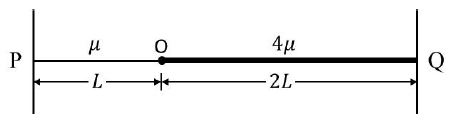
Two uniform strings of mass per unit length 𝜇 and 4𝜇, and length 𝐿 and 2𝐿, respectively, are joined at point O, and tied at two fixed ends P and Q, as shown in the figure. The strings are under a uniform tension 𝑇. If we define the frequency , which of the following statement(s) is(are) correct?
Correct Answer :
With a node at O, the minimum frequency of vibration of the composite string is 𝜈0.
When the composite string vibrates at the minimum frequency with a node at O, it has 6 nodes, including the end nodes.
No vibrational mode with an antinode at O is possible for the composite string.
Solution :
Let us analyze the wave propagation and standing wave conditions on the composite string shown in the figure.
1. Wave Velocities in the Two Strings:
The tension is uniform throughout both strings.
For the left string (segment PO of length and mass per unit length ), the wave speed is:
For the right string (segment OQ of length and mass per unit length ), the wave speed is:
2. Condition for a Node at O:
Both boundary ends P and Q are fixed, meaning they must always be nodes.
If the junction point O is also a node, then both segments PO and OQ act independently as strings fixed at both ends.
For segment PO (length ), the allowed frequencies of vibration are:
where is an integer.
For segment OQ (length ), the allowed frequencies of vibration are:
where is an integer.
For a standing wave to form on the entire composite string, the frequency must be identical in both sections ():
Since and must be integers, the minimum non-zero frequency occurs for , which gives:
Thus, the minimum frequency of vibration with a node at O is:
3. Number of Nodes at Minimum Frequency:
- String 1 (PO) vibrates in its fundamental mode (), having nodes at its ends P and O (2 nodes total).
- String 2 (OQ) vibrates in its 4th harmonic (), having nodes at its ends O, Q and 3 internal nodes (5 nodes total).
- Since the junction O is a common node, the total number of nodes is:
Therefore, there are 6 nodes including the end nodes.
4. Checking for an Antinode at O:
If there is an antinode at O, since P and Q are fixed nodes:
- For PO: The distance from the node P to the antinode O must be an odd multiple of a quarter-wavelength:
- For OQ: The distance from the antinode O to the node Q must be an odd multiple of a quarter-wavelength:
Since , substituting this in:
Equating the two expressions for :
Simplifying:
Since the left-hand side is an even integer and the right-hand side is an odd integer (), there is no integer solution for and . Thus, no vibrational mode with an antinode at O is possible.
Access expert-curated educational resources and study materials—completely free.
Create, conduct, and manage professional online assessments with Mindyard. Perfect for teachers and institutes.
Copyright © 2026 Mindyard. All Rights Reserved.